Rudolf's related claims
Zyklon B quantities, the SS construction documents, and the historical claims that travel with the residue argument.
These sections stood in the residue page until September 2026. They concern claims Rudolf makes alongside the chemistry: how much Zyklon B the gassings needed, what the SS construction documents record, the Höfle, Korherr, Wannsee and Posen documents, witness timings, and the later defenses by Rudolf, Dalton and Mattogno. They are kept here so that the residue page can stay on the chemistry. Page references follow the same conventions as that page.
How much Zyklon B the gassings needed
A gassing that killed within the few minutes some witnesses describe would have needed enormous amounts of Zyklon B, Rudolf argues, so those accounts can't be right. He grants that at least ten minutes to respiratory arrest is technically possible, which drops his later number to 14.2 kilograms.
Rudolf's argument that the gassings would have needed absurd amounts of Zyklon B depends on his choice of timed event and duration. On p. 249 of the 2020 edition he writes that "there seems to be only one witness who has made statements about the actual amount of Zyklon B used: Rudolf Höss," and quotes Höss at "5 to 7 cans of Zyclon B with 1 kg each" for 1,500 people. His footnote 321 adds that the figures in the secondary literature, from 4 to 12 kilograms, either trace to Höss or give no source. He then models seven kilograms, the top of Höss's range, and the sixty-four kilograms comes from his clock rather than from the charge anyone described. His 2003 Table 10 calculates the Zyklon B needed for 1,000 victims to reach respiratory arrest at a given time, assuming a lethal dose of 80 milligrams per person and that the full concentration was available to every victim from the start. Five minutes needs 28.6 kilograms, ten minutes needs 5, and twenty minutes needs 1.23. He writes that the first two lines, "corresponding to execution times of ca. 10 and 15 minutes, respectively, are at the upper limit of witness accounts," so that "an execution within a few moments or minutes would have required enormous amounts of Zyklon B. Such witness accounts are therefore unrealistic." The ten- and twenty-minute rows remain possible, as do accounts that time the door opening and airing rather than the last movement.
The 2020 edition replaces the inhaled-dose model with a room-concentration chain and prints 63.8, 14.2 and 5.8 kilograms at five, ten and fifteen minutes. The change in results between editions reflects the replacement of one model with another. Moving the timed event from five minutes to ten cuts the needed mass from 28.6 to 5 kilograms in 2003 and by 77.7 percent in 2020.
The five-minute assumption treats different witnesses as if they timed the same event. The Vrba-Wetzler account, which passes on secondhand Sonderkommando information, says everyone was dead after three minutes. Shlomo Dragon says everyone was dead within a few minutes, before a doctor looked through the peephole. Miklós Nyiszli, a prisoner doctor, says everyone was dead within five minutes. Rudolf quotes him and gives physicians extra weight, while his footnote 332 sends readers to criticism of Nyiszli. Rudolf Höss says no visible movement after twenty minutes at the latest and the door opened after thirty. Filip Müller's book says quiet in barely ten minutes. Shlomo Venezia says silence after ten to twelve minutes, then a peephole check, opening, the fan, and about twenty minutes of airing. Ya'akov Silberberg says the noise stopped after about ten minutes and the door opened after about fifteen, timing Rudolf's pages don't discuss. Henryk Mandelbaum is given as seven minutes in Rudolf, fifteen to twenty for the gassing in a later interview, and death within thirty in a 1945 statement. Rudolf reproduces only the seven.
Silence, the end of screaming, stopped breathing, a doctor's judgment, the door, and the fan are different events. On p. 260 of the 2020 edition Rudolf concludes that "death in these crematoria occurred after only a few minutes, five at the most," and three pages later defines five minutes as the point when victims were motionless and respiratory arrest had set in, which "does not necessarily mean that they were dead, clinically speaking." The 63.8-kilogram calculation uses time to respiratory arrest, while his witness summary says death.
Rudolf's footnote 330 gives the three-minute Vrba-Wetzler entry, Müller's eight to ten minutes and Mandelbaum's seven, while Dragon, Venezia and Silberberg don't appear. The witness accounts don't establish a single five-minute time to respiratory arrest. It's one selected input behind the 63.8 kilograms, alongside a linear-rise doubling, a one-minute distribution allowance, and a ten percent release fraction read from a magnified graph whose table starts at one hour.
Rudolf distinguishes the literature’s "rapidly fatal" doses from his stricter all-victims endpoint. On p. 192 his own table says 300 ppm. On p. 193 he requires "even the strongest individual, out of all conceivable individual victims, to die in just a few minutes," says that would require several times the listed values, and uses American executions, where Leuchter "speaks of concentrations of hydrogen cyanide used in executions in the USA in the order of magnitude of 3,200 ppm." The footnote traces that number to a fax from Leuchter to defense lawyer Hajo Herrmann and to private communication. Rudolf reproduces no chamber log or instrument reading. Another execution document may exist elsewhere, but his citation doesn't give it. An execution dose from a fax isn't a minimum lethal concentration. Rudolf's table doesn't state a minimum either, and he calls the literature's "rapidly fatal" doses too indefinite for his purpose. The table's generic ‘rapidly fatal’ category doesn't answer his separate requirement that every victim reach a specified endpoint within a few minutes. The source of his execution concentration also doesn't establish it as the necessary operating minimum for that endpoint.
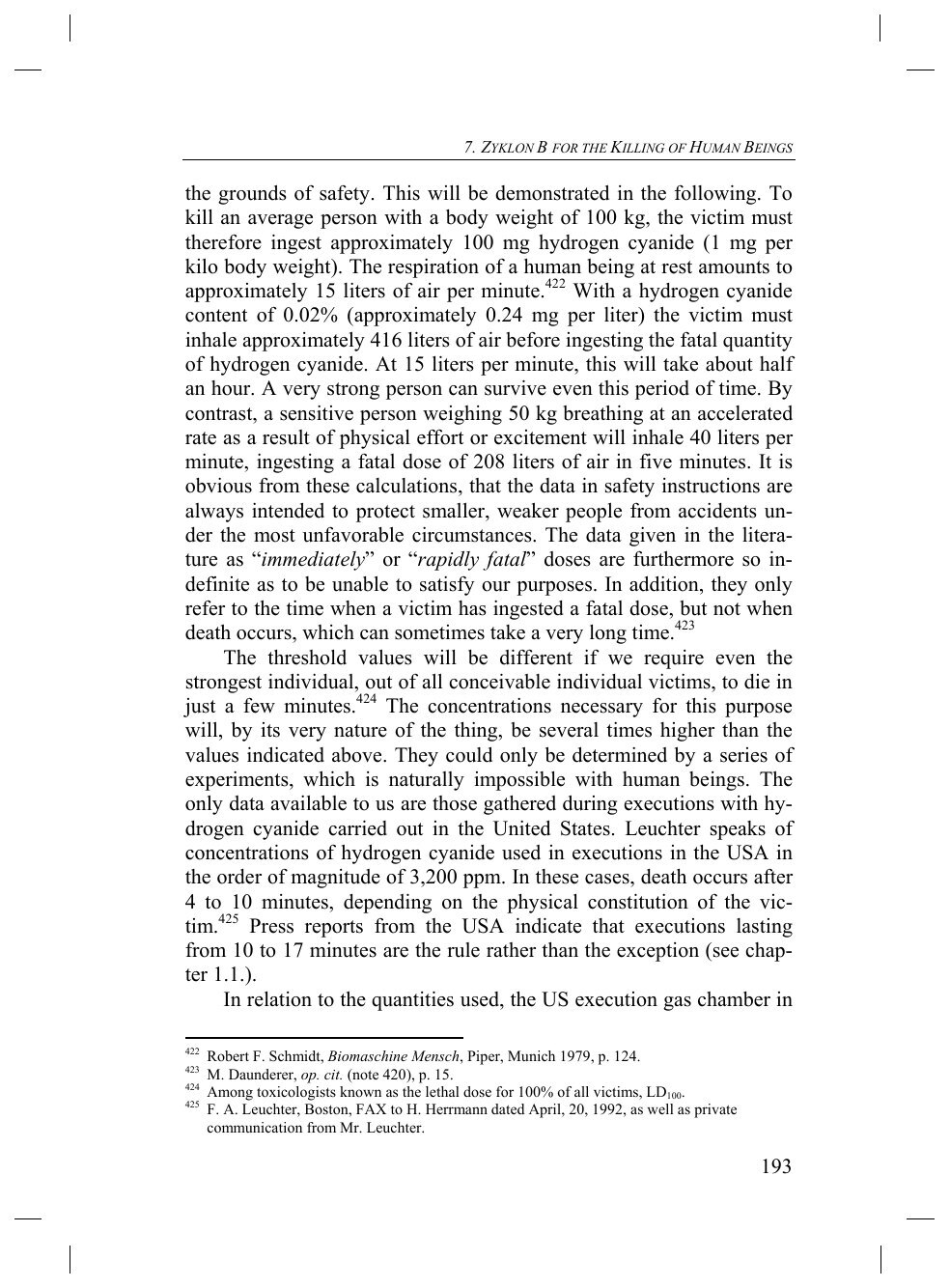
The selected five-minute input doesn’t compel the 63.8-kilogram result. Changing the clock alone doesn’t resolve the separate ten-minute model or validate a complete chamber simulation. This section establishes the dependence on Rudolf’s timing and concentration assumptions.
The SS construction documents
Rudolf's answer to the wartime letter begins, "It is not known which room is being referred to by means of the term 'Vergasungskeller,'" and his 2020 conclusion is that the Auschwitz documentation "does not contain a single reference to execution 'gas chambers'; rather it refutes such suspicions."
The SS construction office called a cellar in Krematorium II the gassing cellar. On January 29, 1943 the head of the Auschwitz Zentralbauleitung wrote to SS-Brigadeführer Kammler in Berlin on the state of the building. The reinforced concrete ceiling of the Leichenkeller, the morgue cellar, couldn't yet be stripped of its formwork because of frost. That didn't matter, the letter says, "da der Vergasungskeller hierfür benützt werden kann," because the gassing cellar can be used for the purpose. The same letter reports that Topf's supply and extraction system, the "Be- und Entlüftungsanlage," had been held up by a rail embargo and would be fitted on arrival so that the building could be fully ready by February 20.
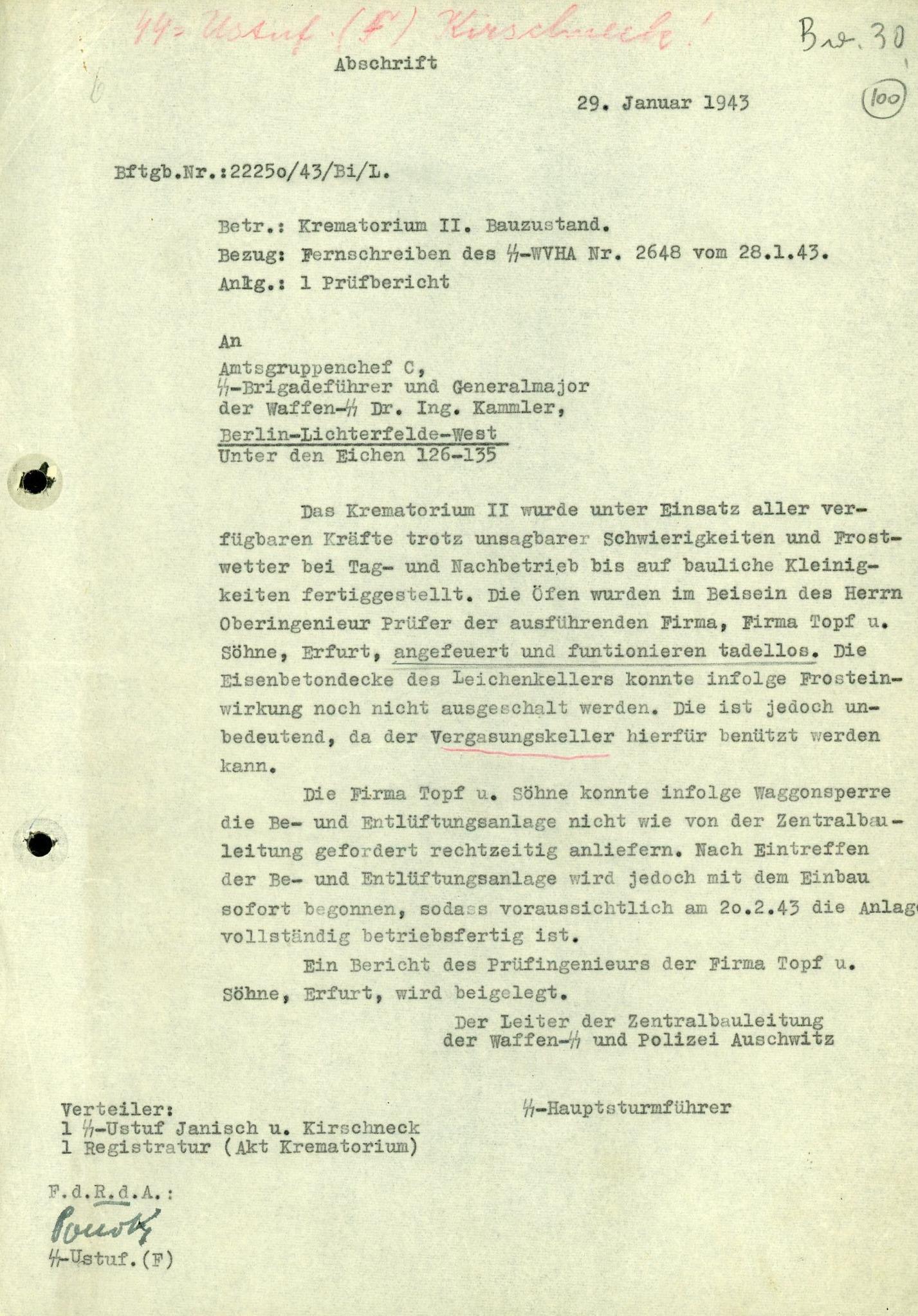
On p. 97 Rudolf lists the letter as "Fact 2: There is a document which mentions a 'Vergasungskeller' (gassing cellar,) in crematorium II," and gives two replies. The first is that the room isn't known. The second is that the construction office considered turning the crematoria into hygiene centers with disinfestation equipment, showers and undressing rooms, then abandoned the plans. The letter alone settles neither the room nor its function.
On pp. 119 to 121 of the 2020 edition Rudolf drops the first reply. He uses a Topf memo of February 17, 1943 about "the aeration blower no. 450 for the gas cellar" to argue that "Gaskeller" and "Vergasungskeller" meant the same room and that the ventilation system identifies it as Morgue 1. He offers two functions. One is an air-raid gas shelter, which he calls "logical to assume," while recording Mattogno's objection that "no document indicates that any of the morgues was equipped as auxiliary air-raid shelters." The other is Mattogno's reading in The Real Case for Auschwitz, pp. 57 to 61, that the SS temporarily planned to use Morgue 1 as a hydrogen-cyanide chamber against the typhus epidemic and borrowed the name from the BW 5a and BW 5b delousing chambers. Mattogno calls that "the most reasonable scenario." He also writes that the files contain no earlier reference to using Morgue 1 for gassing, that the letter answered a telex from Kammler the previous day, so Kammler knew or approved the matter, and that the documents that could explain it "seem to have disappeared, to put it mildly."
Rudolf's hygiene-center documents date from April and May 1943, three to four months after the letter and after the building entered service. The 2020 edition calls the plans "drastically downsized," where the 2003 edition called them "abandoned." On his own side's reading, then, the gassing cellar was Morgue 1 and Berlin knew of it, while its function remains a scenario built on the epidemic rather than a document that names it.
Mattogno's 2000 article lists on pp. 155 to 156 one earlier record, Topf drawing D60446 of June 5, 1942, for a boiler installation intended for Krematorium II. Its other four records run from April 13 to July 28, 1943: a Topf metal list naming "2 Topf Entwesungsöfen für das Krema II," Bischoff's May 14 telegram asking for hot water for about 100 showers, his questionnaire answering "geplant aber nicht ausgeführt" and "für Badeanlagen im Krema. II und III," and a VEDAG invoice headed "Auschwitz-Krematorium." Mattogno says the furnaces went to the Zentralsauna, and that a second VEDAG invoice of the same date names "BW 32 = Entwesungsanlage," the Zentralsauna, which he says proves the first was Zentralsauna work too (p. 157). He concludes that the hygiene-center plan probably came to nothing because the Zentralsauna was under way. The article never identifies the Vergasungskeller. It traces the word to the "Vergasungsraum" of the BW 5a and BW 5b delousing barracks and rejects the air-raid-shelter reading Rudolf later calls logical.
Rudolf also accepts that both Morgue 1 cellars had 4,800-cubic-meter-an-hour intake and outlet blowers while the undressing room had one 10,000-cubic-meter-an-hour outlet blower. On p. 107 he says this shows that the rooms were "designed for typical morgues." On p. 223 the same rate begins an airing calculation he stretches to hours. The chemical argument doesn't disprove these documentary findings, for the reasons given in sections 1 to 9.
Related claims about the gas chambers
Four related arguments accompany the chemistry. Rudolf's 2020 conclusions state three on p. 365, and the fourth is his co-author's.
Rudolf reverses the study's conclusion
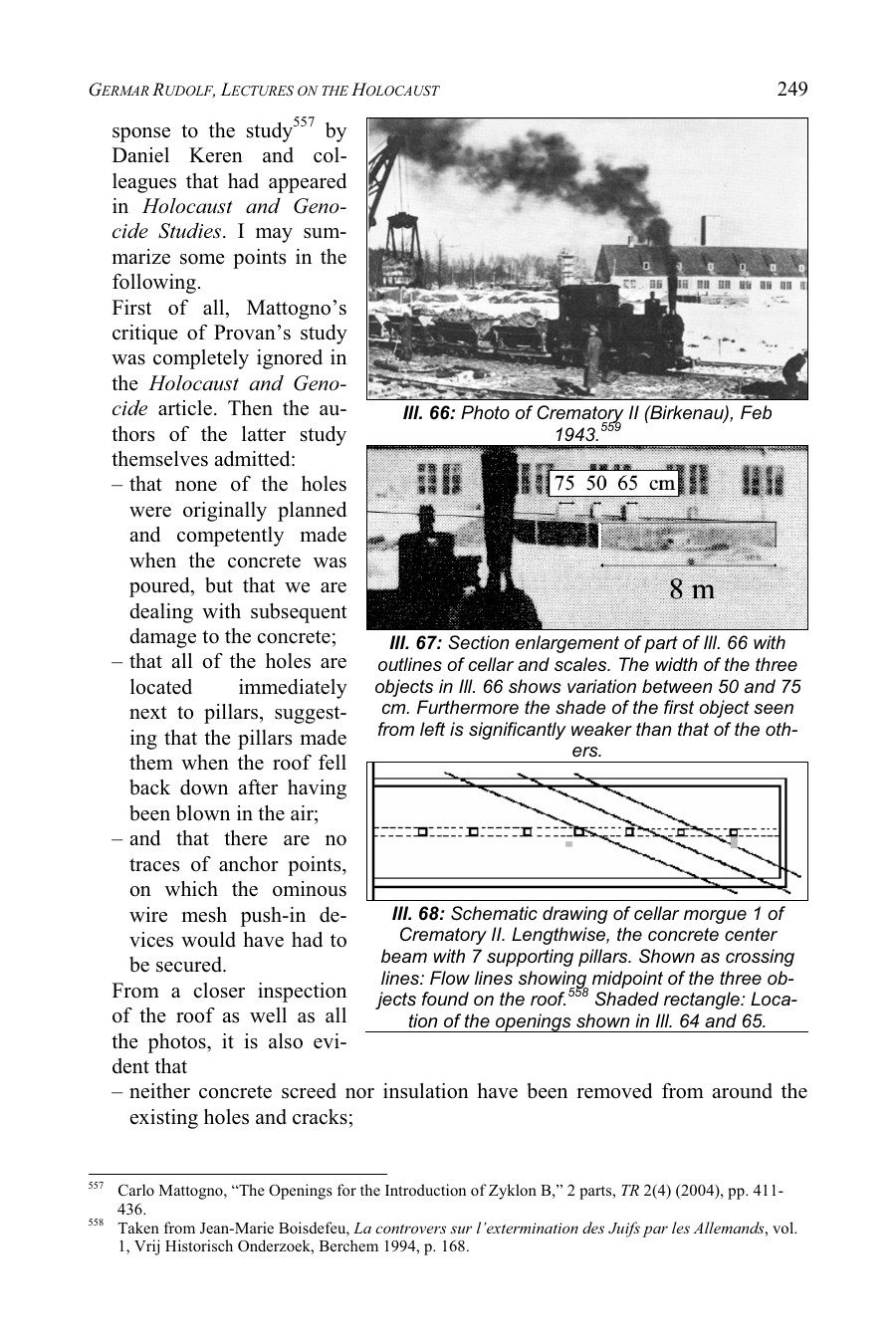
Rudolf attributes to Keren and colleagues a concession their paper explicitly rejects. In the August 2005 Lectures on the Holocaust, p. 249, he says the authors admitted that none of the roof openings were planned and made when the concrete was poured. Their 2004 paper argues that Hole 4 was cast during construction in January 1943. They identify reinforcing bars looped around the opening, with both ends of one loop embedded in concrete, as evidence for that conclusion.
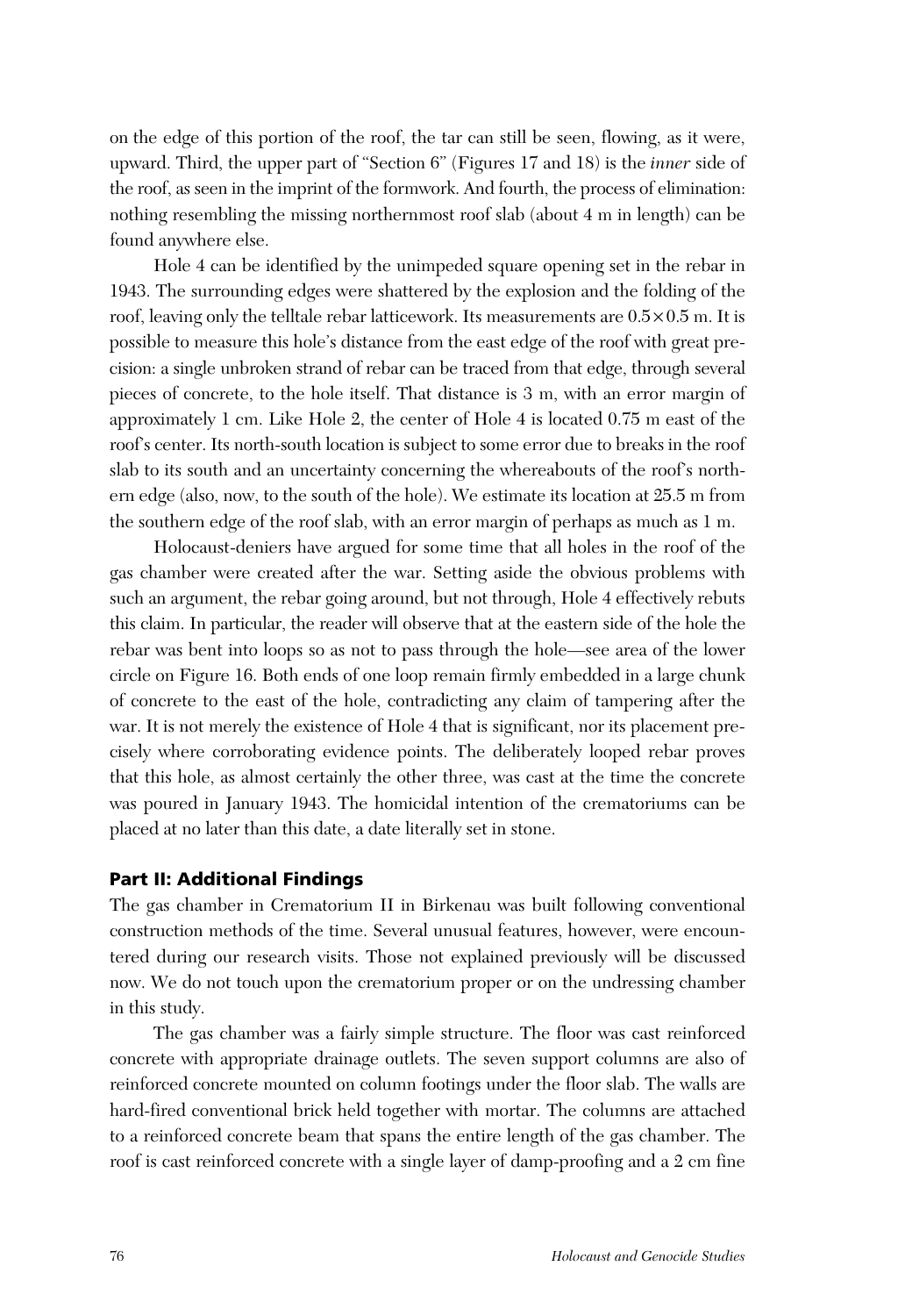
The paper identifies Holes 1, 2 and 4 and projects Hole 3 in an area covered with rubble the authors weren't permitted to move. Its case combines the surviving slab, reinforcing bars and photographs. The paper appeared after the March 2003 English Rudolf Report. The false attribution shown here is in the 2005 Lectures.
Rudolf's later case also invokes opening dimensions, missing anchors, postwar alterations and photograph geometry. His 2020 book, p. 148, directs readers to Mattogno's rebuttal. Mattogno quotes the construction-time conclusion on p. 387 of the 2017 Auschwitz Lies, then disputes the concrete identification and possible alterations on p. 388. Those objections dispute the authors' conclusion. They don't turn it into the opposite admission.
This correction doesn't independently date every opening or establish a cyanide-residue value. It removes Rudolf's claimed concession. The construction features the authors identify still require an answer.
An oven-only capacity calculation omits the pits
Including outdoor burning corrects the scope of an oven-only calculation. Establishing total capacity also requires throughput, operating time, fuel, area, and ground conditions. The small burning example below doesn’t supply those quantities.
The argument that the ovens couldn't have handled the numbers is Carlo Mattogno's rather than Rudolf's. Rudolf quotes Henryk Tauber on pits "full of boiling human fat" and answers that "fat cannot boil at all," it ignites at 180 to 190 °C. He may be right that "boiling" is the wrong word. That objection concerns Tauber's choice of word. It doesn't show that open-air burning didn't happen. Tauber's account in Rudolf's own quotation runs that "the corpses were incinerated in open-air pits, from which the fat flowed into a separate reservoir, dug in the ground. This fat was poured over the corpses to accelerate their combustion." The account is dated to the summer of 1944, and Rudolf's own p. 143 says such burning is possible and cites a shallow-pit test that worked almost completely. Rudolf objects to deep pits because he says they "would have contaminated the drinking water as well, hence would never have been permitted."
The test he reports used a pit roughly 1 meter deep, 70 centimeters wide and 1.2 meters long to burn an 80-pound deer over four to five hours. He concludes that "small, narrow holes are advantageous over large, wide holes" because the soil walls store and reflect heat. Rudolf attaches two conditions, clay in the soil and no ground water flowing in, and says Birkenau was different. The method still works, and the depth his water objection rules out isn't the depth his test used. A capacity calculation that counts only the ovens leaves out a disposal method Rudolf says works.
The witnesses
Agreement about killing and airing preserves a shared claim. It doesn’t by itself answer Rudolf’s accusation of copying or resolve differences between particular accounts. Those questions require the texts and their dates to be compared directly.
Rudolf treats differing witness details as proof of invention. He attacks Filip Müller's later book as copied while citing an earlier Krematorium I account of eight to ten minutes and treating that prisoner account as useful. The short and long accounts agree that the room was used to kill and then aired, which is the point his chemistry was supposed to overturn.
The documents
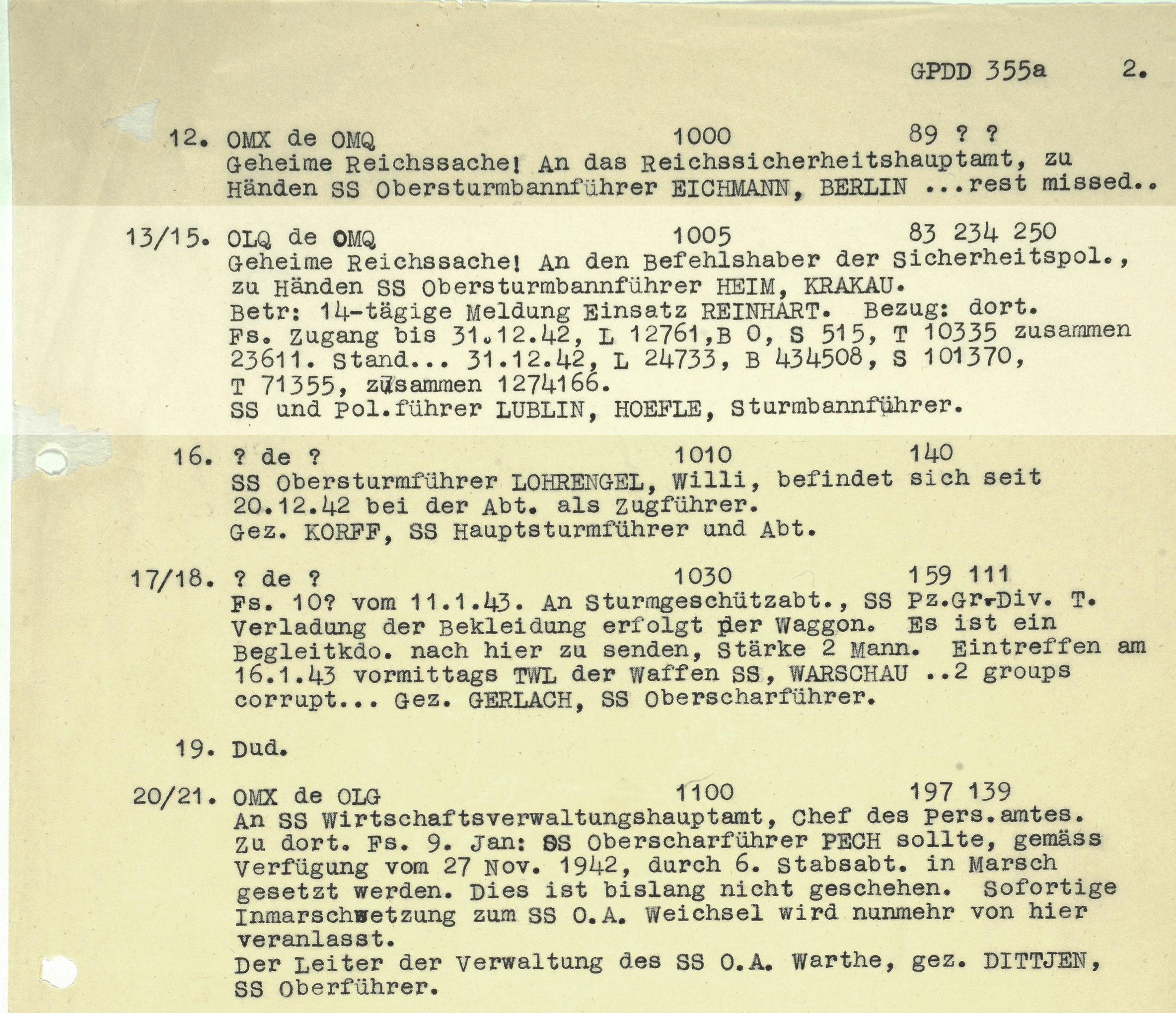
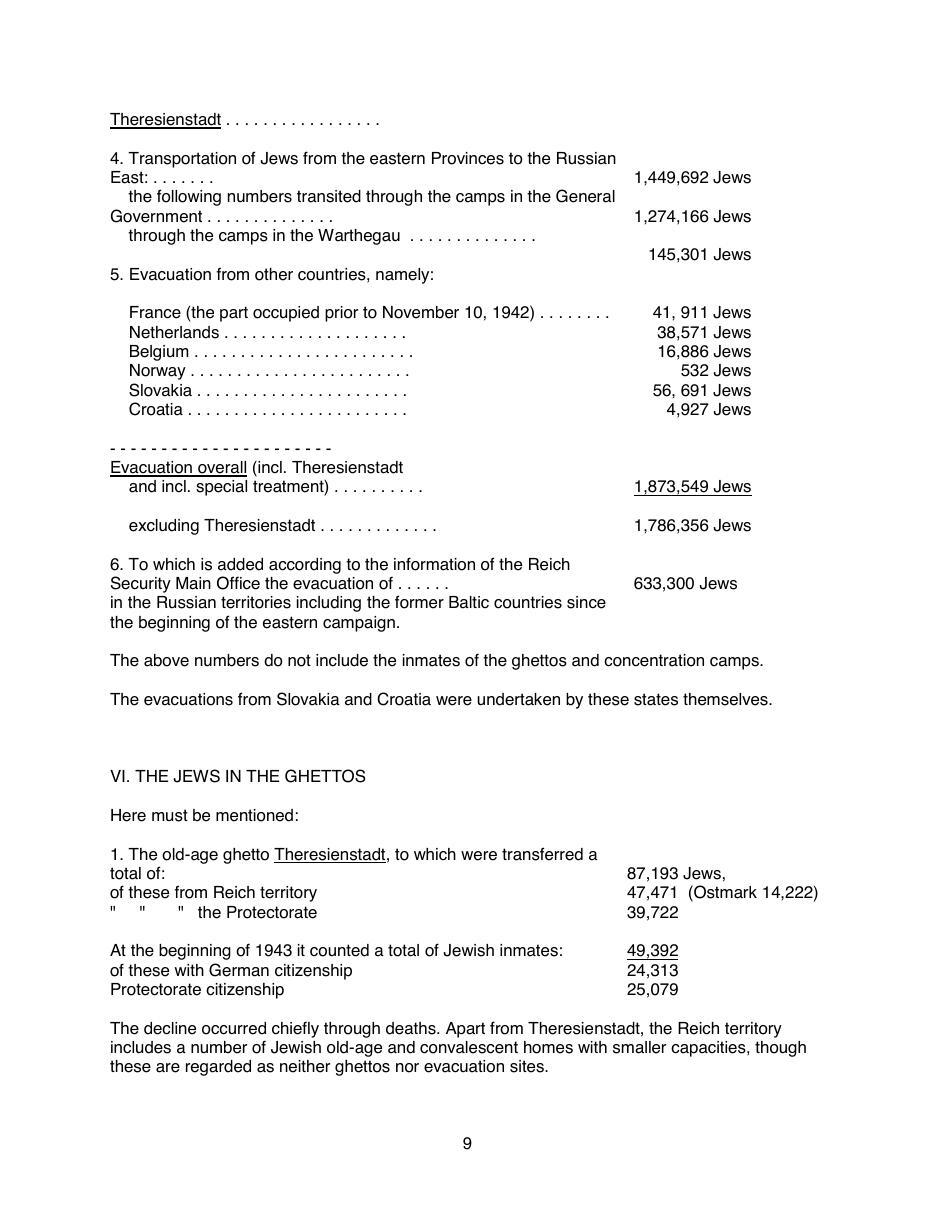
The Höfle telegram of January 11, 1943, intercepted and decoded by British signals intelligence, reports the fortnightly return of Operation Reinhard, with arrivals through December 31, 1942 of 24,733 to Lublin, 434,508 to Bełżec, 101,370 to Sobibór and a Treblinka entry printed as “T 71355,” followed by “zusammen 1274166.” The total requires 713,555 for Treblinka; the decoded entry is one digit short. Richard Korherr's statistical summary for Himmler, two months later, gives the same number, 1,274,166, as the Jews "transited through the camps in the General Government." The Höfle sheet marks the entry "Geheime Reichssache," and the preceding message is addressed to the Reich Security Main Office for SS Obersturmbannführer Eichmann. German offices sent these messages in cipher, and the British read them because they broke it, not because Berlin meant them to be read.
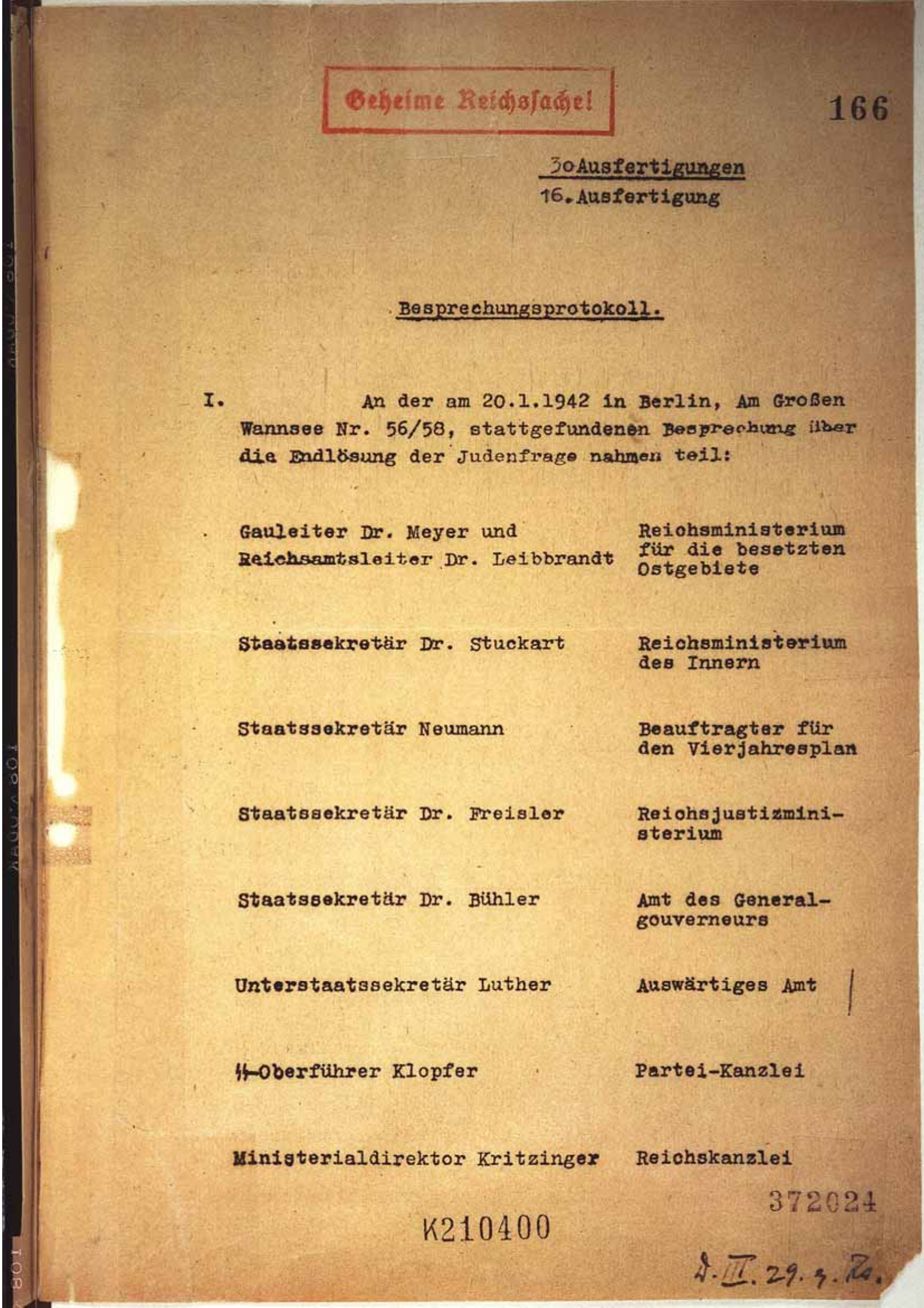
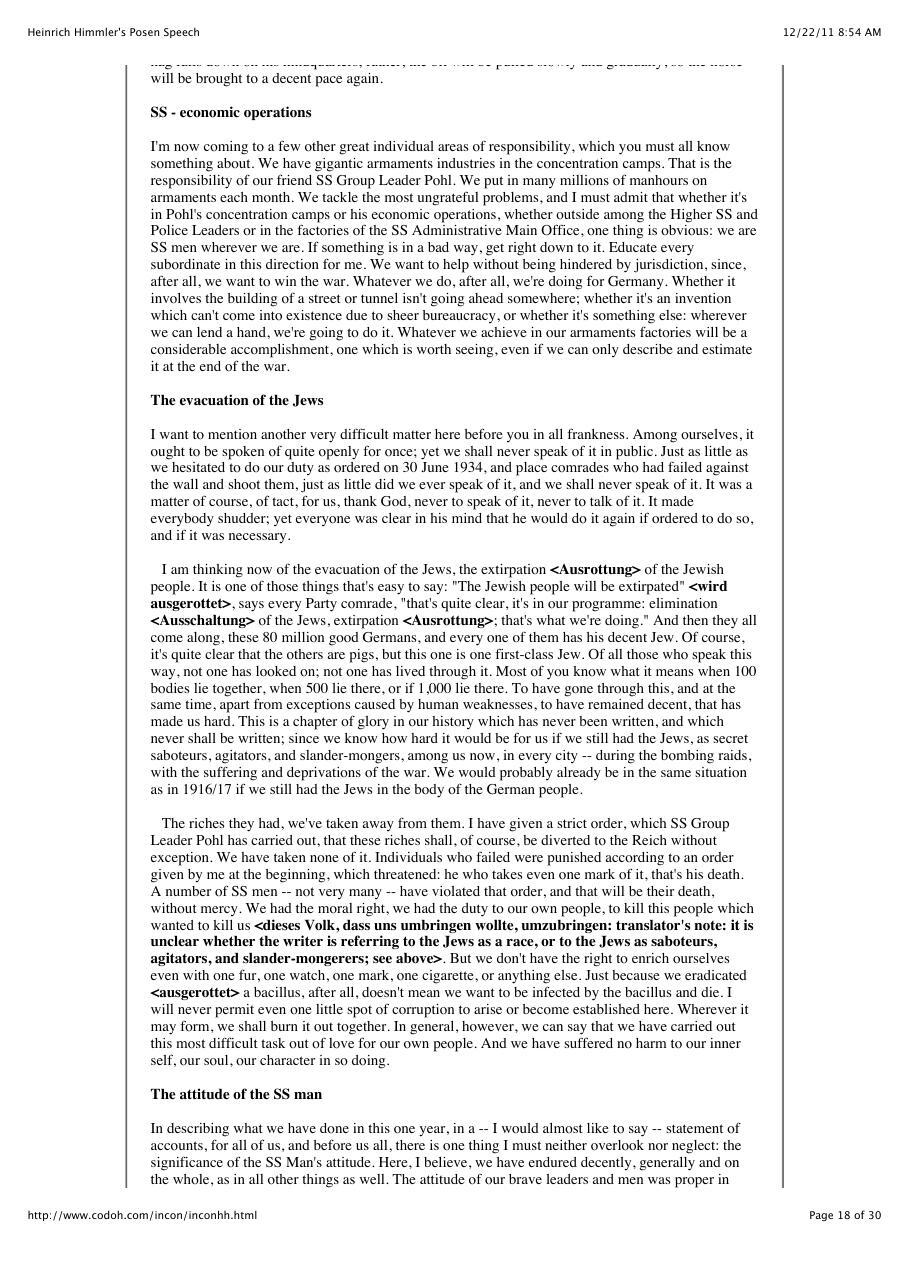
The Wannsee minutes of January 20, 1942, stamped Geheime Reichssache, record the meeting on the "Endlösung der Judenfrage." In his Posen speech of October 4, 1943 Himmler told SS officers that he was speaking of "the evacuation of the Jews, the extirpation (Ausrottung) of the Jewish people," and that this was "a chapter of glory in our history which has never been written, and which never shall be written." A few lines later he tells them: "Most of you know what it means when 100 bodies lie together, when 500 lie there, or if 1,000 lie there." Himmler's own next lines make the killing meaning of Ausrottung clear. The explicit killing language in Himmler's speech helps establish the meaning of the bureaucratic language in the other documents.
Rudolf, Dalton, and Mattogno on the residue argument
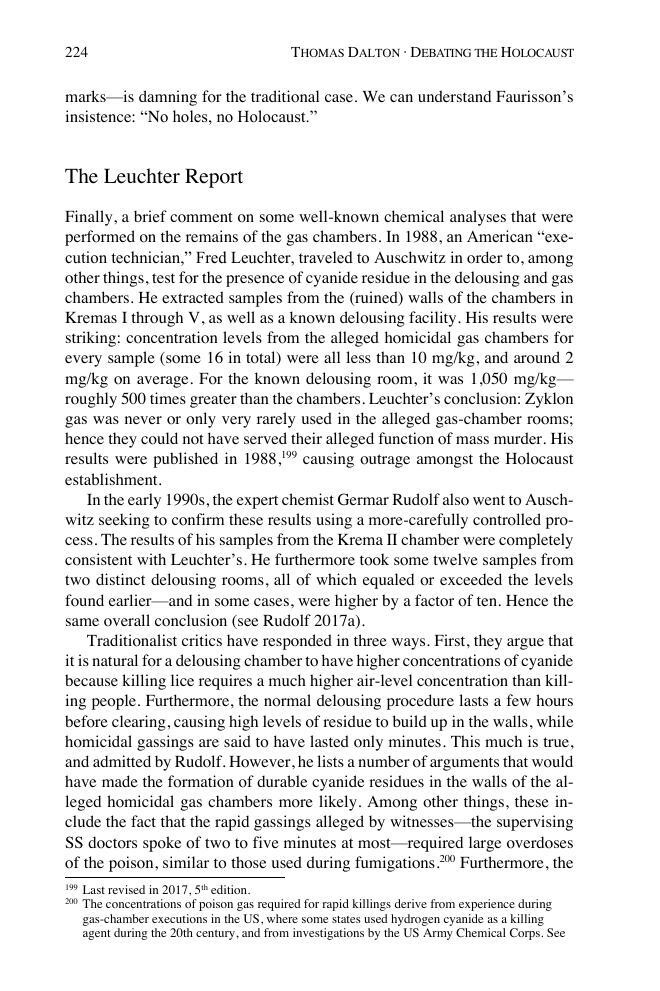
Rudolf calls the Leuchter Report's central inference its "sore spot." Thomas Dalton concedes the exposure contrast, and Carlo Mattogno models twice Rudolf's delousing schedule.
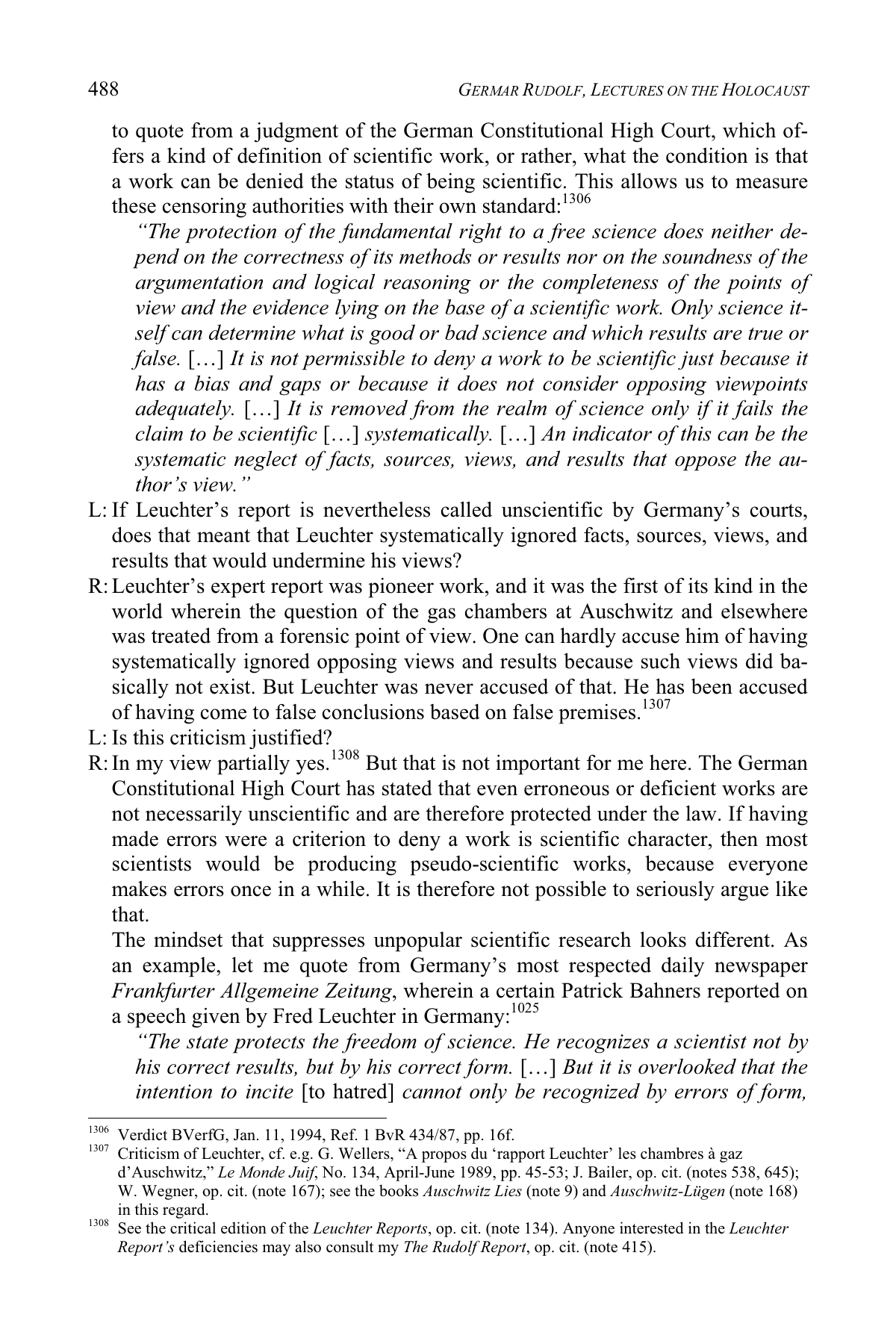
The inference was Fred Leuchter's before it was Rudolf's. In Lectures on the Holocaust Rudolf summarizes Leuchter's 1988 argument as large residues in the delousing room, hardly any in the alleged gas chambers, and an insistence "that just as much residue would have to be found there as in the delousing chambers, if the testimonies about mass gassings were true." Asked whether Leuchter proves it, Rudolf answers on p. 93 that the questioner is "putting your finger right on the sore spot of the Leuchter Report." On p. 488, asked whether the criticism that Leuchter "came to false conclusions based on false premises" is justified, he answers "In my view partially yes." He immediately adds, "But that is not important for me here," and argues that erroneous or deficient work can still be scientific because "everyone makes errors once in a while." He rejects the inference that errors make a work unscientific, but says nothing there about his own chemistry.
His publisher says the same in its catalog. In the back matter of a Castle Hill volume, the blurb for the critical edition of the Leuchter Reports says the first one "was the target of much criticism, some of it justified," and that the edition corrects "those that are inaccurate or false." On the facing page the blurb for The Rudolf Report presents it as the study "which irons out the deficiencies and discrepancies of the Leuchter Report."
Thomas Dalton, in Debating the Holocaust, p. 224, describes Rudolf's sampling as "a more-carefully controlled process" than Leuchter's and concedes the exposure contrast. Critics say a delousing chamber naturally holds more cyanide because killing lice needs a much higher concentration than killing people and because delousing lasts hours while gassings were said to last minutes. Dalton writes, "This much is true, and admitted by Rudolf." He also reports that "The results of his samples from the Krema II chamber were completely consistent with Leuchter's," with some twelve samples from two delousing rooms that equaled or exceeded the earlier levels, so the same objection to Leuchter's inference also applies to Rudolf's.
The exposure contrast is the first of three replies Dalton lists, and the other two are on p. 225. The second is that even corpse rooms "were fumigated periodically" against lice, the explanation Rudolf himself offers as his second alternative on 2020 p. 304, and the section on low readings explains how that possibility conflicts with his claim of no exposure. The third is that the Kraków team "had used a different technique that looked only for unstable cyanide compounds," which the section on the two laboratories answers, and which the institute's own fax of January 24, 1995 had answered in advance: the other compounds "in many cases can persist for periods of almost 50 years" (Auschwitz Lies, p. 57). His verdict on the chemistry is that if the entire revisionist case rested on such data, "they would be on shaky ground," and that the aspect "is relatively indeterminate."
Mattogno assumes two twelve-hour treatments a day in BW 5a and BW 5b. Rudolf's rejected twelve-hour row instead represents constant-concentration exposure. Neither is a recovered BW 5 operating log, and the two quantities can't be equated without a gas-concentration history.
Rudolf presents his book as the technical repair of Leuchter's argument. It replaces Leuchter's assertion that a gas-chamber wall must carry the residue of a delousing wall with a calculation built from a schedule Rudolf assumed and Mattogno models at twice the length, a moisture ratio Rudolf picked, a cement factor he estimated, and an assay limit he acknowledges.
Source list and page references
Sources and page references
Editions and page numbers
Page numbers without an edition refer to Germar Rudolf, The Rudolf Report. Expert Report on Chemical and Technical Aspects of the 'Gas Chambers' of Auschwitz, Theses and Dissertations Press, Chicago, 2003, the 455-page English edition, in which the printed and PDF page numbers agree. Page numbers marked "2011 edition" refer to the 2011 English edition of The Rudolf Report (Theses and Dissertations Press), where printed page N is PDF sheet N+1. For the passages cited most often the editions align as follows: 2003 p. 187 (Table 7 and footnote 410) is 2011 pp. 175 to 176 and 2020 p. 224 (Table 9); 2003 p. 268 (the mortar-test summary) is 2011 p. 253; 2003 p. 283 (the residue formula) is 2011 p. 271 and 2020 p. 358; 2003 p. 289 (the verdict) is 2020 p. 365. The main passages cited from that edition are on pages 16, 21, 97, 107, 152, 160, 165, 169, 171, 177, 178, 179, 187, 188, 192, 193, 202, 215, 216, 217, 223, 245, 246, 247, 251, 252, 268, 270, 272, 282, 283, 284 and 289. Page numbers marked "2020 edition" refer to Germar Rudolf, The Chemistry of Auschwitz, Castle Hill Publishers, 2020, where printed page N is PDF sheet N+1. Pages 27, 28, 29, 119 to 121, 182, 183, 303, 307, 360 and 365 of that edition are reproduced or discussed here. Further 2020 references (pp. 222 to 223, 238, 260, 265 to 268, 281 to 285, 300, 311, 328, 335, 341 to 343, 358 to 359) support the discussions of pigment formation, gas release, ventilation, and laboratory results.
Other works cited
- Germar Rudolf and Nicholas Kollerstrom, "Differential Exposure of Brickwork to Hydrogen Cyanide during World War Two," Inconvenient History 5, no. 1 (2013), pp. 18 to 38, for the repeat and spike tests and the closing methods statement.
- Germar Rudolf, "Critique of Claims Made by Robert Jan van Pelt," April 10, 2000, p. 34, for the rule that results below 10 mg/kg can't be interpreted; the original 1993 English study, pp. 63 to 64, for sample 28; Germar Rudolf writing as Ernst Gauss, "Die 'Gaskammern' von Auschwitz und Majdanek," in Grundlagen zur Zeitgeschichte (1994), p. 385, for the 3.6-ton supply example.
- Germar Rudolf, Lectures on the Holocaust, Castle Hill Publishers, 2014 edition, printed pp. 93 and 488.
- Germar Rudolf, Lectures on the Holocaust, August 2005 edition, p. 249, for the account of Keren and colleagues. Germar Rudolf and Carlo Mattogno, Auschwitz Lies, fourth edition, March 2017, pp. 373 to 407, especially pp. 387 to 388, for the later rebuttal.
- Castle Hill Publishers back matter printed in Carlo Mattogno, Auschwitz: Crematorium I, 2016 printing, pp. 142 and 143.
- Carlo Mattogno, The Real Case for Auschwitz, 2019 printing of the 2015 second edition, printed pp. 57 to 61 and 495 to 497.
- Thomas Dalton, Debating the Holocaust, PDF, printed pp. 224 to 225.
- Germar Rudolf and Carlo Mattogno, Auschwitz Lies, Castle Hill Publishers, 2017 printing, printed pp. 57 to 58, for the Kraków institute's fax of January 24, 1995; The Chemistry of Auschwitz 2020, printed pp. 119 to 121, for the Vergasungskeller reply.
- Daniel Keren, Jamie McCarthy and Harry W. Mazal, "The Ruins of the Gas Chambers: A Forensic Investigation of Crematoriums at Auschwitz I and Auschwitz-Birkenau," Holocaust and Genocide Studies 18, no. 1 (2004), pp. 68 to 103, PDF, printed pp. 75 to 76 and 95.
- John Clive Ball, The Ball Report, Ball Resource Services, Delta, British Columbia, 1993, PDF, printed pp. 10 to 11.
- Carlo Mattogno, "Leichenkeller von Birkenau: Luftschutzräume oder Entwesungskammern?," Vierteljahreshefte für freie Geschichtsforschung 4, no. 2 (2000), pp. 152 to 158, pp. 154, 156 and 157.
- Jan Markiewicz, Wojciech Gubała and Jerzy Łabędź, "A Study of the Cyanide Compounds Content in the Walls of the Gas Chambers in the Former Auschwitz and Birkenau Concentration Camps," Z Zagadnień Nauk Sądowych 30 (1994), pp. 17 to 27, Tables I, III, IV, V and VII, from the printed scan.
- D. Grosser and E. Roßmann, "Blausäuregas als bekämpfendes Holzschutzmittel für Kunstobjekte," Holz als Roh- und Werkstoff 32 (1974), pp. 108 to 114, pages 108, 111, 112 and 113.
- L. Schwarz and W. Deckert, “Experimentelle Untersuchungen bei Blausäureausgasungen,” Zeitschrift für Hygiene und Infektionskrankheiten 107 (1927), pp. 798–813, especially pp. 800, 801, and 803; Part II, volume 109 (1928), pp. 201–211, especially p. 201. Rudolf cites Part II as 1929. Table 7 combines both papers.
- M. A. Alich, D. T. Haworth and M. F. Johnson, Journal of Inorganic and Nuclear Chemistry 29 (1967), pp. 1637 to 1642; W. A. Uglow, Zeitschrift für Hygiene 108 (1928), pp. 108 to 123; H. A. El-Sayed, Cement and Concrete Research 11 (1981), pp. 351 to 362; L. Moggi and colleagues, Journal of Inorganic and Nuclear Chemistry 28 (1966), pp. 2589 to 2598; J. M. Kape and E. C. Mills, Transactions of the Institute of Metal Finishing 35 (1958), pp. 353 to 384; E. Peters and E. Wüstinger, Zeitschrift für hygienische Zoologie 32 (1940); Richard Irmscher, Zeitschrift für hygienische Zoologie und Schädlingsbekämpfung 34 (1942), pp. 35 to 37.
- Jan Markiewicz, Wojciech Gubała and Jerzy Łabędź, method p. 20, standards and repeat analyses p. 21, Table I p. 22, Table III p. 23, Table IV p. 24, Table V and the month-long series p. 25, Table VII p. 26, from the printed scan.
- Bethany L. Todd, Nicholas F. Wogan and David C. Catling, "Kinetics of Ferrocyanide Formation," ACS Earth and Space Chemistry 8 (2024), pp. 221 to 229, Table 1, for the solution rate laws that motivate the capture exponents on the calculation page.
- The sensitivity sweep of the wall model (19 capture exponents, 7 mobile capacities, 3 pulse widths, each combination recalibrated to Rudolf's mortar endpoint) and the separate-pool variant are reproducible from the equations printed on the calculation page.
- Joseph Epstein, "Estimation of Microquantities of Cyanide," Analytical Chemistry 19, no. 4 (1947), pp. 272 to 274, April 1947 issue.
- Richard J. Green and Jamie McCarthy, "Chemistry is Not the Science: Rudolf, Rhetoric and Reduction" (1999), for the conditional sentence and the sentence that Prussian blue is not a good marker for exposure.
- Gideon Greif, We Wept Without Tears, printed pp. 111, 195, 225 to 226, 320 and 323 to 324; Jean-Claude Pressac, Auschwitz: Technique and Operation of the Gas Chambers, 1989, pp. 171, 483 to 484, 494 and 500; The Auschwitz Protocol: The Vrba-Wetzler Report, p. 12; Miklós Nyiszli, Auschwitz: A Doctor's Eyewitness Account, p. 83; Rudolf Höss, Commandant of Auschwitz, p. 222; Filip Müller, Eyewitness Auschwitz, p. 116; Shlomo Venezia, Inside the Gas Chambers, p. 69; Sonder: An Interview with Sonderkommando Member Henryk Mandelbaum, p. 39. These accounts provide the witness timings discussed above alongside Rudolf's footnote 330.
- Letter of the Leiter der Zentralbauleitung der Waffen-SS und Polizei Auschwitz to Amtsgruppenchef C, SS-Brigadeführer Kammler, January 29, 1943, Bftgb. Nr. 22250/43/Bi/L, on the construction state of Krematorium II, wartime certified copy.
- Decoded German message of January 11, 1943, sheet GPDD 355a, National Archives, Kew, HW 16/23; Richard Korherr, statistical summary, English translation, p. 9; Wannsee minutes, January 20, 1942, p. 1, high-resolution facsimile; Himmler's Posen speech of October 4, 1943, English translation, p. 18.
Further experimental source pages
P. G. Stock, “The Utilization of Lethal Gases in Hygiene,” Proceedings of the Royal Society of Medicine 31 (1938), pp. 427–442, p. 438; Page, Lubatti, and Gloyns, “The ventilation of houses after fumigation with hydrogen cyanide,” Journal of Hygiene 39 (1939), pp. 12–34, p. 29. The linked full pages above identify the studies and preserve their surrounding discussion.
The later experimental comparisons use the original pages reproduced above: Zagury and colleagues (2004), pp. 213 and 215; Meeussen and colleagues (1994), p. 791; Rennert and colleagues (2005), p. 531; Rennert and Mansfeldt (2009), PDF p. 4; Kang and colleagues (2010), p. 1395. Their materials and starting cyanide compounds differ from the Auschwitz wall comparison. Uglow’s additional heating result is on p. 122 of the 1928 paper.
Calculated and measured concentrations
The 450 to 1,810 ppm range in Green and McCarthy's 1999 reply is a calculated floor for five to fifteen minutes, not a measured concentration.