Rudolf's residue calculation
His comparison with the delousing walls doesn't establish the residue his conclusion requires.
The form of Rudolf's argument
Rudolf's comparison hasn't established the necessity his conclusion requires. His argument has a simple form. If these morgues were used for the gassings he describes, his reconstruction says their walls should retain high cyanide concentrations; the measured concentrations are low; so he concludes that those gassings did not occur (2020 edition, p. 365; 2003 edition, p. 289). The form is valid. The first premise is not established, and his own pages show why.
His expectation is not a measurement. He compares the morgues with delousing walls under an assumed history of prolonged, repeated exposure (2020 edition, pp. 284 and 357). His delousing samples R12 and R13 gave 2,900 and 3,000 milligrams of cyanide per kilogram. He scales those figures by three estimated factors and prints the result as a relative range, "≈ 0.8 to 8" in the 2020 edition (p. 358) and "≈ 0.4–8" in the 2003 and 2011 editions (pp. 283 and 271), where the 0.4 is an arithmetic slip for 0.84. The corrected low endpoint compares his 14.4-minute equivalent exposure for the morgue, assuming introduction columns and near-perfect ventilation, with the inner-surface value from his repeated six-hour delousing scenario (2020 edition, pp. 284 to 286, Table 22). Applied to R12 and R13, his corrected low end still expects about 2,400 to 2,500 milligrams per kilogram in the morgue wall. R3, plaster from the western wall of Morgue 1 in Krematorium II, gave 6.7 milligrams per kilogram initially (2011 edition, p. 239, Table 20) and was below detection on retest (p. 243, Table 21).
| Comparison | Chamber ÷ delousing |
|---|---|
| Initial sample results | 6.7 ÷ 2,900 ≈ 1 to 433 R3 was below detection on retest |
| Rudolf's corrected lower bound, his shortest exposure branch | 16 ÷ 19 ≈ 1 to 1.19 |
| Seven conditional variants under the same schedules | Paired ratios from 1:352 through 1:10.5 |
He does not present that expectation as certain. He leaves the effect of carbon dioxide out of the calculation and says its influence "is not known" (2020 edition, p. 286, note 355). He allows that little Iron Blue may have formed, or that residues may have been destroyed, for unknown reasons, and he says that an "extensive series of tests" would have been necessary for a better prediction (2011 edition, pp. 272 to 273; 2020 edition, p. 360). He then concludes that the gassings cannot have happened as described. The distance between the qualified estimate and the categorical conclusion is the subject of this page.
The measurement conflicts sharply with his conditional expectation. Because the transfer assumptions needed to make that expectation a lower bound have not been established, the conflict does not establish his exclusion. It does not settle the history either way by itself. The residue evidence supports prior HCN exposure in the morgue ruins. Rudolf distinguishes uptake from later reactions, but his numerical comparison does not establish how those processes determine the lasting residue recovered from the two kinds of wall. A conserving model with separate capture and escape can reproduce a large contrast in total retained cyanide under stated assumptions, without destroying captured product. That is mathematical compatibility, not a validated reconstruction of these walls. The seven variants on the calculation page are checked alternatives, not an uncertainty interval; their reaction laws, material transfer and exposure histories haven't been jointly established for these walls, and R3 is a selected specimen, not a room average.
What the Kraków institute found in the morgue ruins
The Kraków institute, Rudolf writes, "used the micro-diffusion chamber procedure, which does not permit the detection of Iron Blue" (2011 edition, p. 231), and what its samples from the alleged gas chambers show "is practically nothing" (2003 edition, p. 283).
The Kraków institute did not fail to find cyanide in the morgue ruins. The authors chose a procedure that did not decompose Prussian blue, checked that property on a standard, and measured cyanide released as HCN by acidification and microdiffusion (Markiewicz, Gubała and Łabędź 1994, p. 20). Standards ran with every series and positives were repeated (p. 21). It returned positive readings from thirteen of fourteen Krematorium II and III specimens, with individual determinations up to 640 micrograms per kilogram (p. 23, Table III). All eight designated dwelling controls in Table I were reported as zero (p. 22); the table describes them as probably fumigated once, so the contrast is between materials with different exposure histories, not between exposed and never-exposed walls. Table IV includes a nearby dwelling sample at 4, 4 and 4 micrograms per kilogram, at the study's reported analytical floor (p. 24).
The same procedure gave up to 900 micrograms per kilogram in delousing samples (p. 24, Table IV). Rudolf's separate total-cyanide analyses of Birkenau delousing material gave thousands of milligrams per kilogram. These were not paired determinations on the same specimens. The repeated detections and the contrast with the designated controls support prior HCN exposure in the morgue material. These readings do not by themselves determine the number, duration or purpose of the exposures. Those questions require the historical record.
The two sections that follow take up what each laboratory measured and what Rudolf's own limits on low readings allow him to infer.
The two laboratories counted different things
The Kraków institute's 1994 study, which found cyanide in the crematoria, used what Rudolf's heading on p. 270 labels a "False Method of Analysis," one that can't see Iron Blue, so its results are "a waste of time."
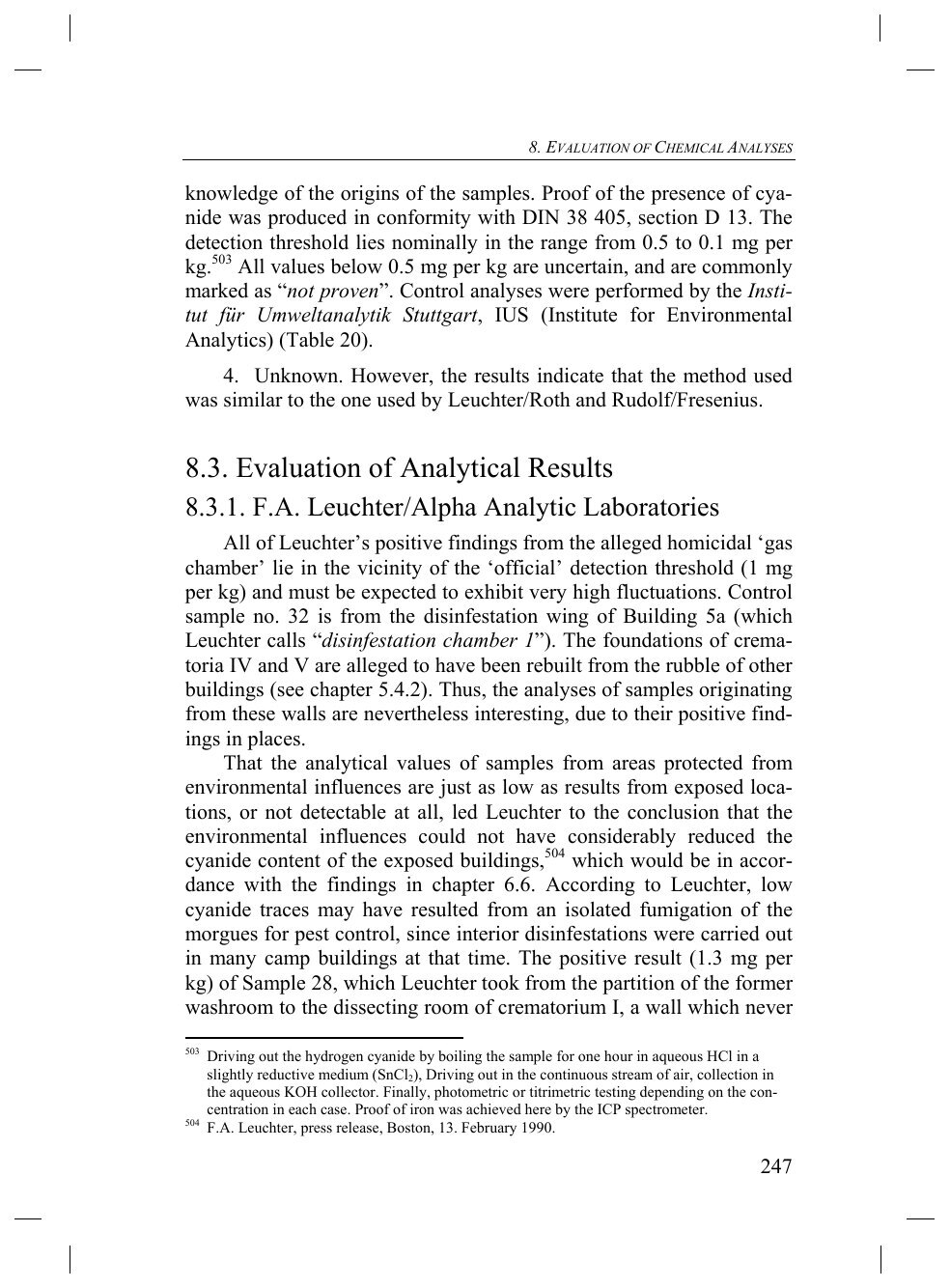
Rudolf's laboratory and the Kraków laboratory didn't measure the same quantity. His own method, described in a footnote on p. 247, boils the sample for an hour in hydrochloric acid with a tin salt and collects what is driven off. That breaks stable Iron Blue apart and counts its cyanide. The Kraków institute, as he writes on p. 246, "used the micro-diffusion chamber procedure, which does not permit the detection of Iron Blue." The total assay can include pigment-bound cyanide. Appearance and these unmatched measurements don't establish which compound fraction dominates in either room type. The Kraków method asks whether cyanide other than the pigment remains in a wall, and it asks the same question of every room. Neither set should be discarded. These datasets can't be subtracted directly to estimate Prussian blue because the specimens and recoveries weren't matched. Properly matched and validated assays of nested fractions could estimate an excluded fraction; identifying it as pigment would require further evidence.
The crematoria weren't blank by the Kraków method. In the institute's Table III, six of the seven sample groups from Krematorium II gave three detections each, the highest set at 640, 592 and 620 micrograms per kilogram, while the dwelling controls in Table I were zero. Table III's heading is "Crematorium chambers (or their ruins)," so it doesn't put each result on a Morgue 1 wall. Those detections don’t contradict “practically nothing” as a description of their small size. They do matter to the comparison with the dwelling controls; the assay reported a difference, not uniformly blank samples. Its Block 3 delousing samples included a set at 900, 840 and 880.
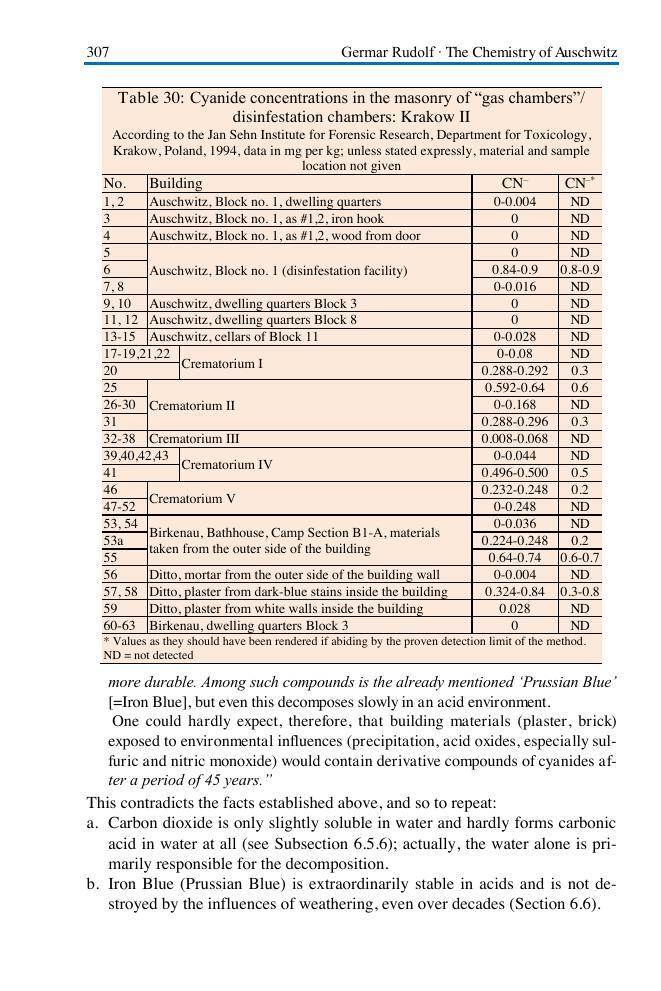
Rudolf replies that carbonate-rich masonry near the detection limit can give false positives, and on p. 303 of the 2020 edition says the reliability of such results "is approaching zero." Interpreting these small values requires control and recovery evidence. The results don't independently resolve the missing-pigment comparison. A method that leaves the pigment alone still reported cyanide above its dwelling controls in the crematorium ruins. His own Table 30 on p. 307 reprints Krematorium II at 0.592 to 0.64 milligrams per kilogram and the dwellings at zero. Correcting one mislabeled row in that table helps Rudolf.
On p. 272, the column headed "Cyanide without iron cyanide" gives Kraków readings of 0 to 0.8 mg/kg for delousing chambers and 0 to 0.6 for the 'gas chambers.' Removing the pigment from the measurement puts both groups in a low band. That doesn't explain the large total-cyanide difference: the excluded pigment is the very substance Rudolf says should also occur in the morgues. The Kraków measurements address a different fraction and can't substitute for a formation-and-retention calculation.
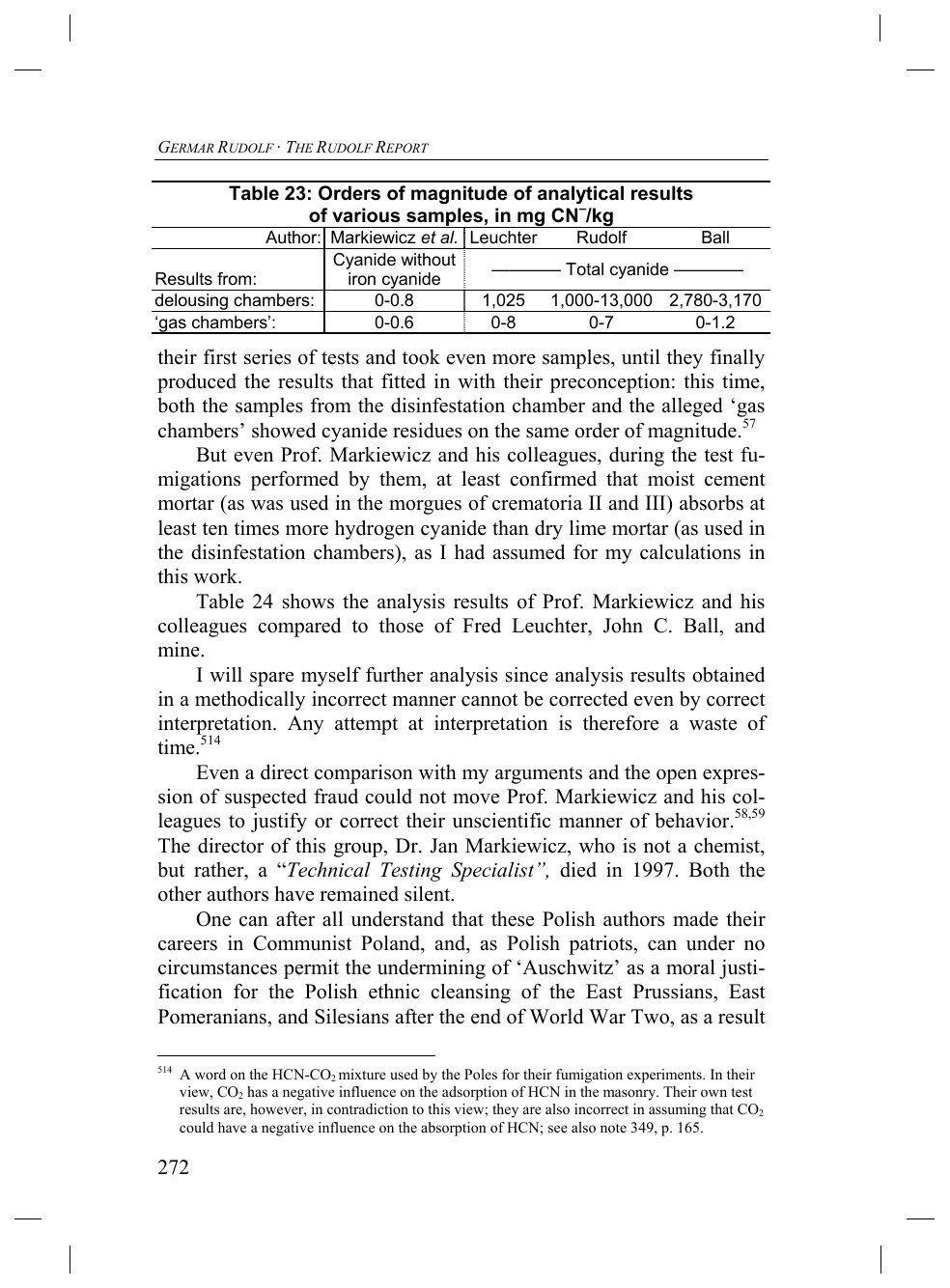
On p. 343 of the 2020 edition, Rudolf takes carbon dioxide factors of 247, 27 and 3 from the Kraków rows, alongside a fourth factor of 0.14 that runs the other way, and a tenfold moist-mortar factor from the Kraków wet-and-dry test. A study that is "a waste of time" on p. 342 supplies figures he leans on one page later, offered conditionally as values that would support his assumed material contrast if taken seriously.
Rudolf's sensitivity objection compares a concentration in liquid with a concentration in wall material without the required conversion. The institute stated a floor of 3 to 4 micrograms per kilogram of sample, "under present circumstances." On p. 300 of the 2020 edition Rudolf sets against it a paper by Joseph Epstein, printing Epstein's 0.2 mg/L as "200 µg/kg" expressly "for aqueous solutions." He contrasts that aqueous figure with the institute's sample-based threshold without the required conversion. The 0.2 figure is Epstein's lowest calibration standard in liquid, not a masonry limit he stated. On p. 246 of the 2003 edition Rudolf states the Kraków threshold as a fact, "The detection threshold for other cyanides lies at 10 µg per kg sample material," with no objection. The Epstein complaint is absent from the 2003 edition and appears from the 2011 edition (p. 231) onward, where the passage argues for 200 µg/kg, twenty times the figure the 2003 edition printed. Turning a liquid reading into micrograms per kilogram of plaster needs the sample mass, the liquid volumes used to extract and collect the cyanide, and the recovery of the whole procedure, which Rudolf's cited pages don't give. Rudolf 2020, page 300.
Epstein's paper neither confirms nor defeats the Kraków floor. The complete paper states no detection limit. Its summary says that "as little as 0.2 microgram of cyanide can be estimated with an accuracy of 99 ± 4% standard deviation," its calibration runs on standard solutions of 0.2 to 1.2 micrograms per milliliter, and its discussion reports recovery of 98 to 100 percent across that range. The 0.2 microgram per milliliter was the smallest quantity Epstein tested, not a stated limit of detection.
Low readings and the claim of no exposure
Rudolf infers a history of no exposure from the low readings. The 'gas chamber' walls hold no more cyanide than a random building, so they "most likely were never exposed to any hydrogen cyanide."
Rudolf's stated limits on interpreting low readings undermine his claim that the morgues weren't exposed in 1943. On p. 247 he writes that the method's detection threshold lies "in the range from 0.5 to 0.1 mg per kg," that "All values below 0.5 mg per kg are uncertain," and that Leuchter's positive findings near the 1 mg per kg threshold "must be expected to exhibit very high fluctuations." On p. 283 he writes that the homicidal gas chambers "contain such low cyanide concentrations that they are neither capable of reproducible detection nor of adequate interpretation." Those limits prevent a precise inference from an individual tiny result. They don't prevent a sound assay from distinguishing a few milligrams from thousands. On p. 304 of the 2020 edition he even lists possible prior Zyklon B fumigation as one explanation for the crematoria readings, although he ranks the explanation that they "are equivalent to zero values" as the most probable.
Rudolf and Nicholas Kollerstrom's 2013 paper reports sample reanalyses and a check in which a laboratory added a known amount of cyanide to a sample. The publication date isn't the date of those tests. Rudolf's own account distinguishes two reanalyses and a spike check by Leuchter's laboratory from four of Rudolf's specimens retested by another laboratory. Rudolf 2020, page 302. Five of the six repeat tests, and the one spike check, fell outside the paper's own acceptable range of plus or minus 25 percent. His Morgue 1 sample R3, which had read 6.7 milligrams per kilogram, came back below detection when another laboratory retested it. Even a high sample fell from 2,640 to 1,430. The paper's closing section says a reliable method for carbonate-rich solid material such as old plaster was still needed before the results could support definite conclusions, and on p. 303 of the 2020 edition Rudolf writes: "The reliability of analytic results of masonry samples rich in carbonate with cyanide levels close to the formal detection limit is approaching zero." He gives the benchmark on the same page, a spike recovery "of up to ±10%" for a reliable method and acceptability limits "generally considered to be at ±25%," against his own masonry results "between +40% and −100% near the detection limit." The broad split between the two groups of walls survives. Low-end uncertainty doesn't answer Rudolf's strongest argument, which is the absence of the large residue he predicts. That prediction must be tested chemically.
Two bricks came from one demolished Bavarian farmhouse. The untreated brick, sample 25, gave 9.6 milligrams per kilogram, and was the only sample in his set that gave the same value twice on retest. Rudolf fumigated sample 26 for sixteen hours at 0.3 percent hydrogen cyanide, stored it for 120 days, and tested it. It gave 0.1 milligrams per kilogram, one ninety-sixth of the untreated brick's reading, and later runs found no detectable cyanide. He calls the result paradoxical, suggests an improperly cleaned ball mill may have contaminated the untreated brick, and concludes: "These findings prove that cyanide values up to 10 mg per kg have only very limited probative value." The exposed brick read far lower than the untreated brick. Its result shows why a low value can't be converted directly into a history of exposure. A comparison with Morgue 1 still requires the material conditions. The formation section examines what Rudolf’s model establishes about those conditions.
R26 was an unsealed brick with a different exposure and storage history from the fresh-mortar experiment. It defeats a blanket rule that exposed material must yield a large residue, but it isn’t a matched test of Rudolf’s proposed Morgue 1 minimum.
Table 36 in the same edition gives 2.5 milligrams per kilogram as the mean of his eleven control results, and that average counts laboratory runs, not separate specimens. Two specimens were analyzed twice. Sample 8 enters as 2.7 and 0.5, and the 9.6 brick enters twice at the same value. Averaging both pairs and counting each specimen once gives about 1.8, and dropping the farmhouse specimen he himself suspects of contamination leaves an eight-specimen mean of about 0.9. He discloses the repeats. The printed average gives one brick double weight.
Rudolf's 1993 English study took Leuchter's sample 28, from a washroom wall in Krematorium I, at 1.3 milligrams per kilogram and treated it as proof that the trace wasn't caused by homicidal gassing. In his April 2000 reply to Robert Jan van Pelt he states, on the same page where he discusses sample 28, that results below 10 milligrams per kilogram can't be interpreted. The reading he used as proof in 1993 is 87 percent below his later threshold. His separate argument that the washroom partition was never part of the alleged gas chamber remains a point in his favor. His later threshold invalidates the chemical proof he attached to the 1.3 reading.
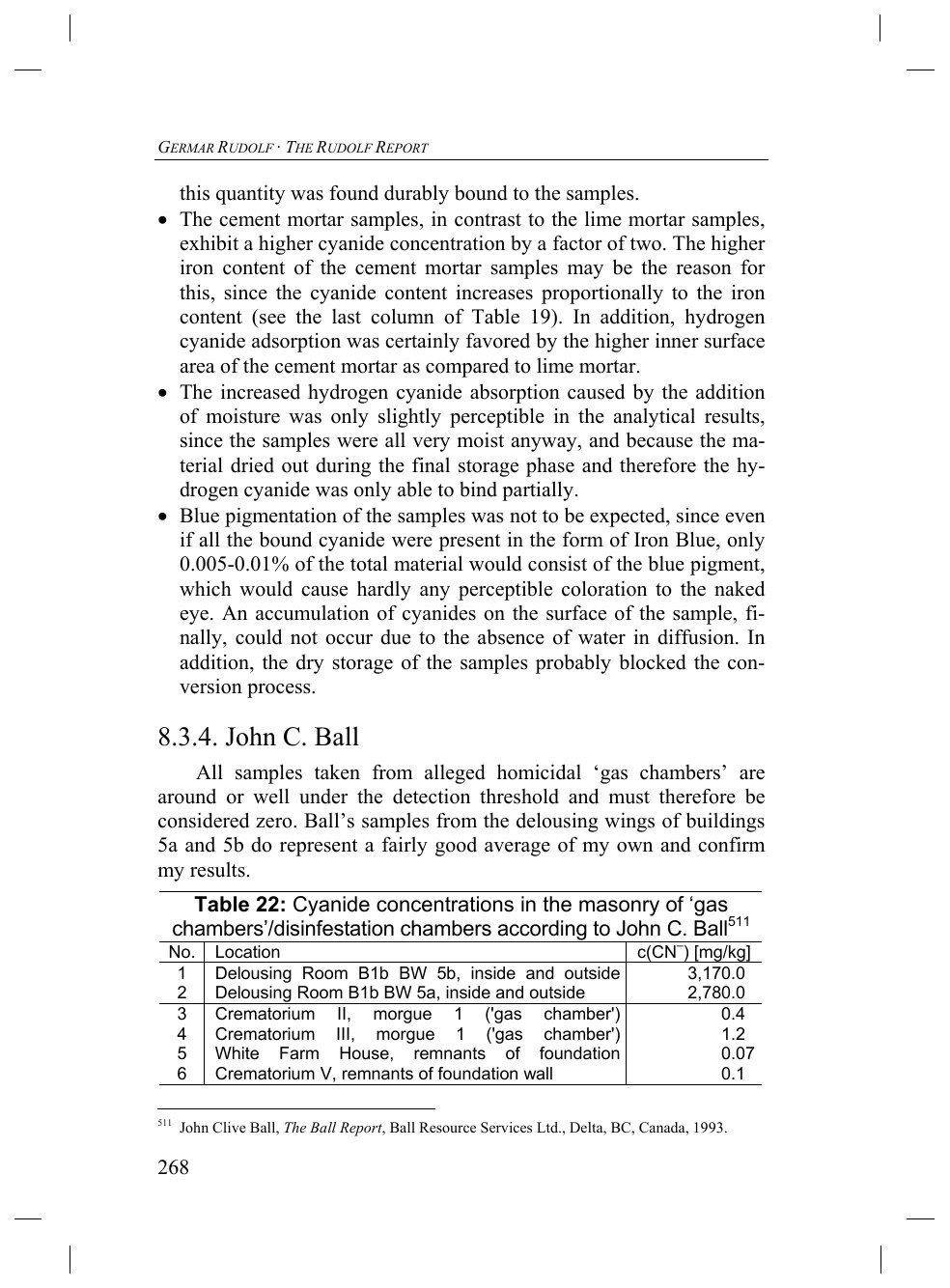
John Ball's samples, which Rudolf prints on p. 268 as confirming his results, don't confirm his depth pattern or room-to-room comparison. Ball's report gives its figures as averages over ten bags of surface scrapings from each location, with no depth stated. His two delousing entries are the same site, described as outside brick and inside cement and mortar, so his 3,170 and 2,780 milligrams per kilogram are two averages from one location. The labels BW 5b and BW 5a are Rudolf's, not Ball's. A surface average from one site can't confirm Rudolf's depth pattern or room-to-room readings, and Ball names no laboratory, analyst or method. Ball's report says figures under 1.5 milligrams per kilogram count as zero because the equipment couldn't measure them accurately. Rudolf omits that limit and the missing method while rejecting other tests on those grounds. Ball reports 0.4 for Krematorium II Morgue 1 and 1.2 for Krematorium III Morgue 1, then classifies both averages as zero. That limit describes what the equipment could resolve, not what the walls held.
Rudolf's samples and conclusion
Rudolf took wall samples at Auschwitz and Birkenau and had the Fresenius Institute test them for total cyanide. By his own account on p. 252, "only a few samples were taken from the alleged homicidal 'gas chambers,'" and the gathering "took place chiefly in the disinfestation chambers of Buildings 5a and 5b." His summary table on p. 272 of the 2003 English edition sets four sets of results side by side in two rows, and three of the four columns, his own included, measure total cyanide. By that method the delousing chambers gave 1,000 to 13,000 milligrams of cyanide per kilogram of wall. The rooms he labels 'gas chambers' gave 0 to 7, and the three Morgue 1 samples behind that row gave 0.6, 6.7 and 7.2, the zero being a re-analysis of the 6.7 that came back below detection.
The total doesn't identify what the cyanide was. Rudolf's note under Table 19 on p. 254 explains that his %Fe column gives the "Portion of total iron content converted to Iron Blue, assuming that all detected cyanide was present as Iron Blue." The assay returns one number for every cyanide compound the method breaks open, and the share that was pigment is an assumption in his table, not a measurement. The low single-digit readings are uncertain because his repeat tests turned several into "not detected."
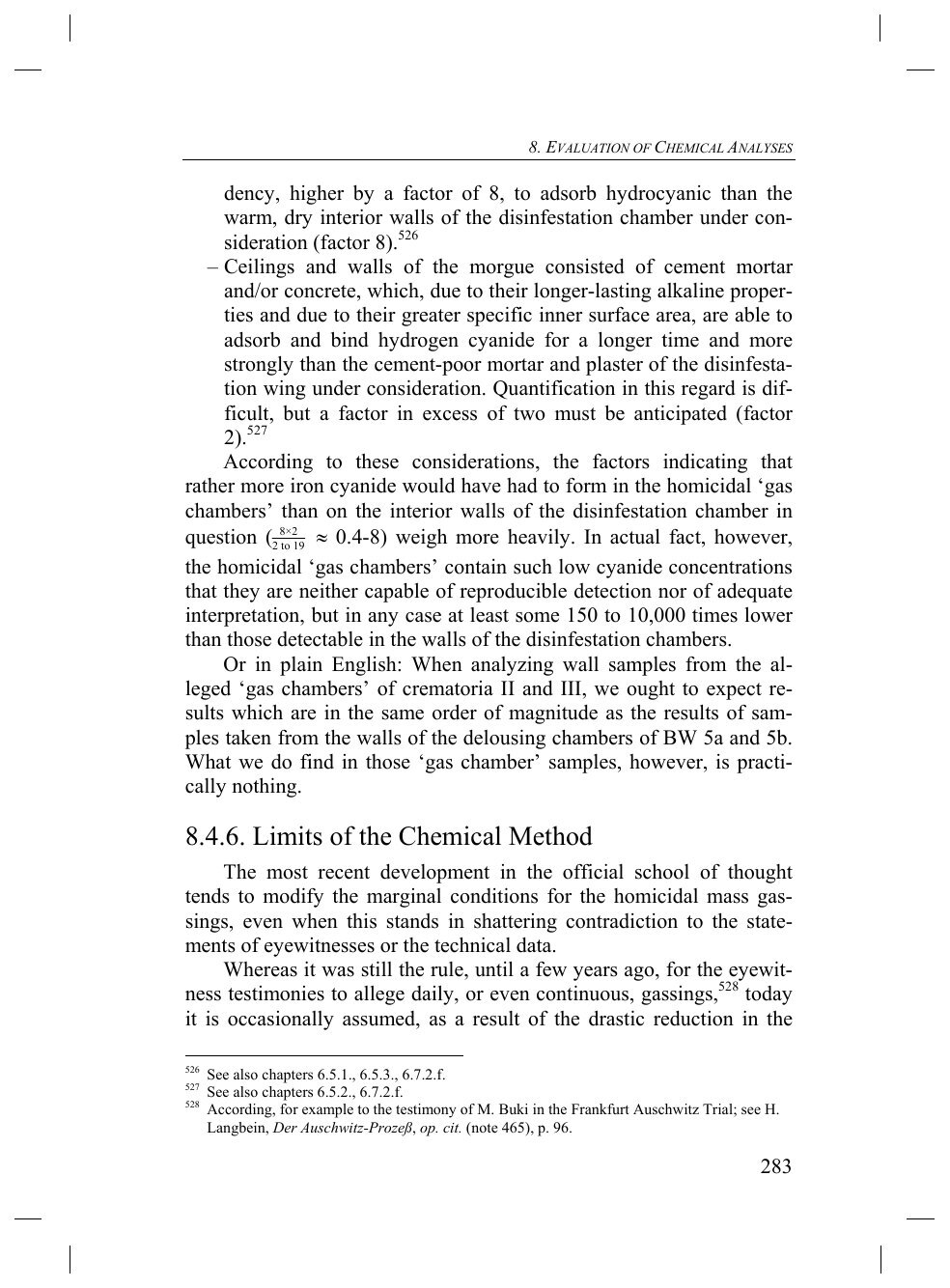
Rudolf's reading is on p. 283, in what he labels "plain English." When we test wall samples from the alleged gas chambers of crematoria II and III, he writes, "we ought to expect results which are in the same order of magnitude as the results of samples taken from the walls of the delousing chambers of BW 5a and 5b. What we do find in those 'gas chamber' samples, however, is practically nothing."
Different modeled exposure times
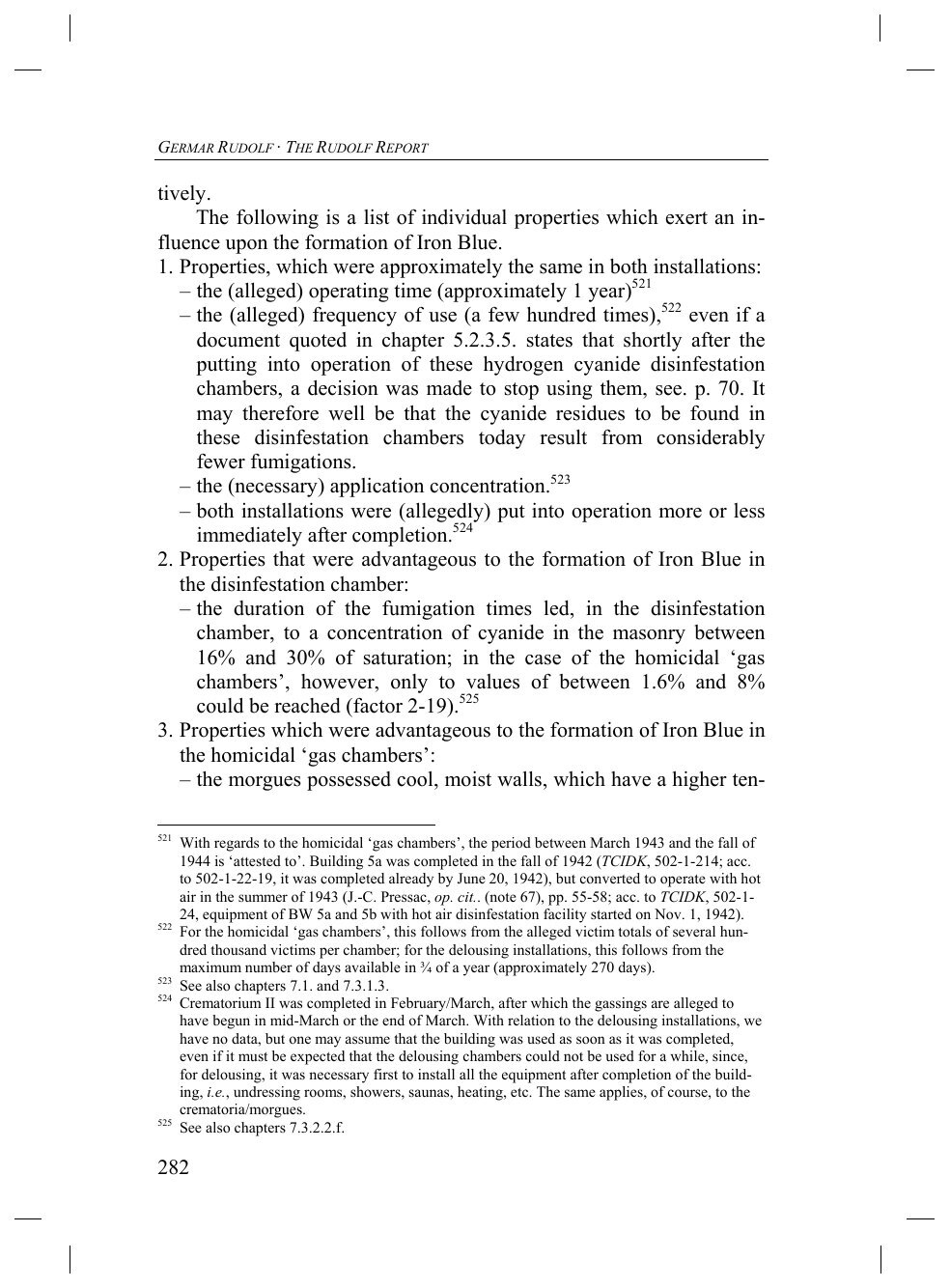
He then treats the two rooms as comparable on what he lists as properties "approximately the same in both installations," an alleged operating time of about a year, an alleged frequency of use of a few hundred times, the necessary application concentration, and prompt entry into service, so the delousing wall is a fair yardstick for the morgue.
By Rudolf's own model the delousing masonry reached 2 to 19 times the saturation of the morgue masonry before he applies his other factors. That is a modeled wall-saturation ratio, not a measured dose. He supplies no site-specific exposure history for either room, so a change to the 2-to-19 term could run in either direction. On p. 282 he sets out the properties he treats as "approximately the same in both installations," and then the ones that favored the delousing chamber. The fumigation times there, he writes, drove the masonry to "between 16% and 30% of saturation," while in the alleged gas chambers "only values of between 1.6% and 8% could be reached (factor 2-19)." The two ends aren't readings of one comparison. The 2 is his highest morgue figure against his lowest delousing figure, and the 19 is his lowest morgue figure against his highest delousing one, so the range combines the extremes of four assumed numbers. It isn't an uncertainty range around a measured ratio. He then applies two other factors that increase his predicted morgue residue relative to the delousing residue.
In Rudolf's model the two rooms differ because he assigns them different exposure times, not different gas concentrations. He gives both rooms the same assumed 10 grams of hydrogen cyanide per cubic meter of air, an input no BW 5 operating log supports, and assigns different durations: six hours of daily delousing contact through the year against minutes for a gassing. Rudolf's toxicology table on p. 192 gives the human numbers behind the short side. At 300 parts per million of hydrogen cyanide in air the effect is "rapidly fatal," at 100 to 200 ppm "lethal within ½ to 1 hour." The lethal times in his table are shorter than the hours he assigns to delousing. Thomas Dalton, writing for Rudolf's side in Debating the Holocaust, concedes the point on p. 224. Traditionalist critics, he writes, say it is "natural for a delousing chamber to have higher concentrations of cyanide because killing lice requires a much higher air-level concentration than killing people," and that "the normal delousing procedure lasts a few hours before clearing, causing high levels of residue to build up in the walls, while homicidal gassings are said to have lasted only minutes." His verdict is "This much is true, and admitted by Rudolf," before he turns to Rudolf's reasons the morgue should have formed more pigment anyway.
The uptake test didn’t measure lasting residue
Rudolf argues that damp cement more than offsets shorter exposure. The delousing walls therefore set a high expected residue for the morgue walls.
Rudolf combines an uptake measurement with arguments about chemical binding. That is an attempt to predict residue, but it doesn’t establish the numerical connection between gas taken up and cyanide found decades later. A supported relative bound could make his case without a complete reaction law. His qualitative arguments about dampness, alkalinity, and iron don’t supply that bound. In the 2020 edition, he also expressly leaves open a carbon-dioxide effect on irreversible binding.
The factors in Rudolf’s prediction
On p. 283, Rudolf calculates the morgue-to-delousing residue ratio from three chosen factors.
Rudolf’s printed range is shown here. Correct arithmetic gives 0.84 to 8 and strengthens his lower bound.
The 8 is a moisture factor for the morgue's cool, damp walls. The 2 is a factor for cement mortar against the lime of the delousing room. The 2 to 19 is the modeled saturation contrast from the section on modeled exposure times. The result is his prediction that the morgues should have formed between 0.4 and 8 times the delousing room's pigment, which is where "same order of magnitude" comes from. Rudolf's range crosses one at both editions' printed values. His formula therefore permits the morgue walls to have formed less Iron Blue than the delousing walls as well as more. His sentence on the same page that the factors show "rather more iron cyanide would have had to form" in the morgues rests on the upper part of that range. The plain-English expectation he states next, results "in the same order of magnitude," is the most his own bracket supports.
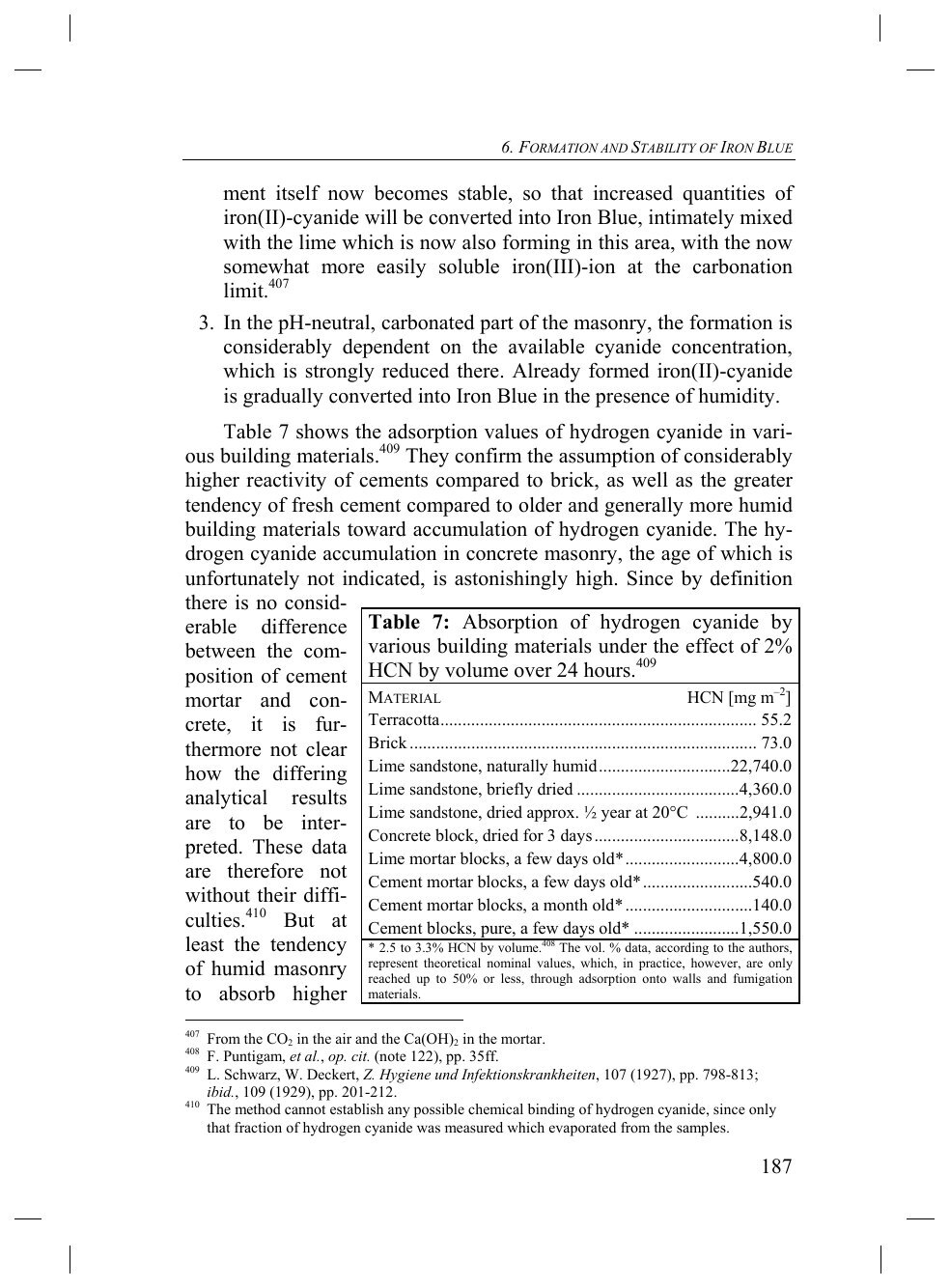
The factor of eight measures HCN recovered by heating
The 8 comes from Part II of Schwarz and Deckert’s study, published in 1928 and cited by Rudolf as 1929. His Table 7 on p. 187 of the 2003 edition (Table 7 on p. 175 of the 2011 edition; Table 9 on p. 224 of the 2020 edition) combines that paper with their 1927 Part I. Lime sandstone gave 22,740 milligrams of recoverable HCN per square meter when naturally damp and 2,941 after about half a year of drying, a ratio of 7.73. A briefly dried row gives 4,360, or a contrast of 5.22. Rudolf uses the larger contrast, rounded to eight. Footnote 410 (the same sentence stands in the body text on p. 176 of the 2011 edition and p. 224 of the 2020 edition) says the method “cannot establish any possible chemical binding of hydrogen cyanide, since only that fraction of hydrogen cyanide was measured which evaporated from the samples.” The contrast is substantial. It measures a recoverable HCN pool, not the fraction converted to lasting pigment.
The original method separates gas release from bound cyanide
Schwarz and Deckert’s 1927 paper describes heating samples in a carbon-dioxide stream, collecting released HCN in silver nitrate, and measuring it by Volhard titration. Part II says the method remained the same in principle, with larger enamel vessels. This is consistent with Rudolf’s footnote distinguishing released HCN from chemical binding. The authors’ warning that their results were minimum values concerns actual gas exposure falling below the nominal concentration. It isn’t a guarantee that the assay recovered every cyanide compound.
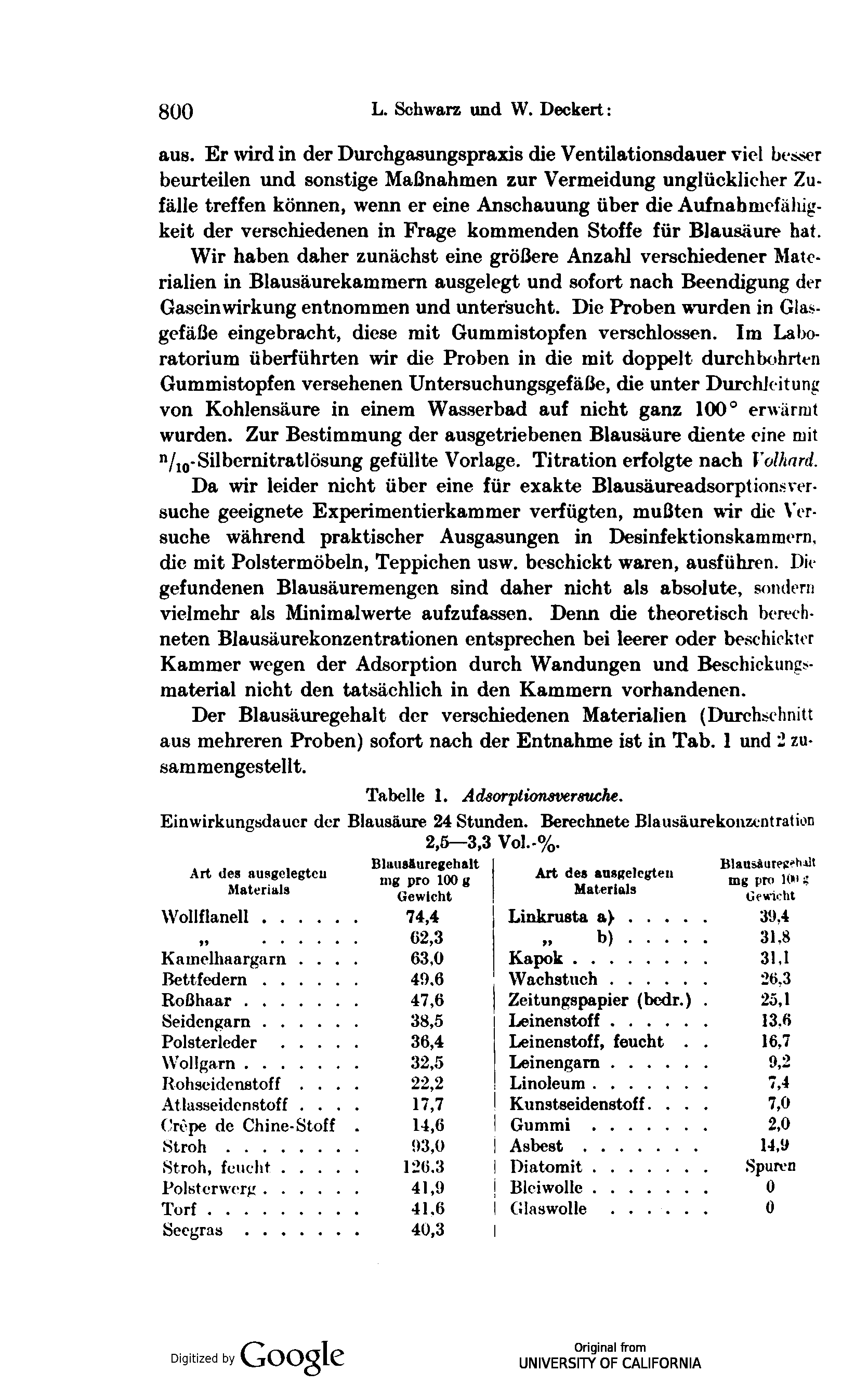
English translation of the relevant passage
We therefore first placed a larger number of different materials in hydrogen-cyanide chambers, removed them immediately after the gas exposure ended, and examined them. The samples were placed in glass vessels, which were closed with rubber stoppers. In the laboratory we transferred the samples into examination vessels fitted with rubber stoppers with two holes. While carbon dioxide was passed through, the vessels were heated in a water bath to just under 100°. A receiver filled with N/10 silver nitrate solution served to determine the hydrogen cyanide driven off. Titration was performed according to Volhard.
Since we unfortunately had no experimental chamber suitable for exact hydrogen-cyanide adsorption tests, we had to carry out the experiments during practical fumigations in disinfection chambers loaded with upholstered furniture, carpets, etc. The quantities of hydrogen cyanide found must therefore be understood as minimum values, rather than absolute values. In an empty or loaded chamber, the theoretically calculated hydrogen-cyanide concentrations don’t correspond to those actually present because of adsorption by the walls and the material loaded into it.
These are the two paragraphs describing the method and its exposure limit.
The same paper contains a more revealing contrast. Scrapings of wall paint gave only traces of HCN on dry heating, but treatment with tartaric acid followed by distillation gave about 10% bound HCN. Changing preparation exposed a much larger recoverable pool. The account doesn’t give the exposure history, identify the compound, or establish the percentage as a share of the original gas dose. It therefore supports a concrete method warning, not a ten-percent retention law for Auschwitz plaster.
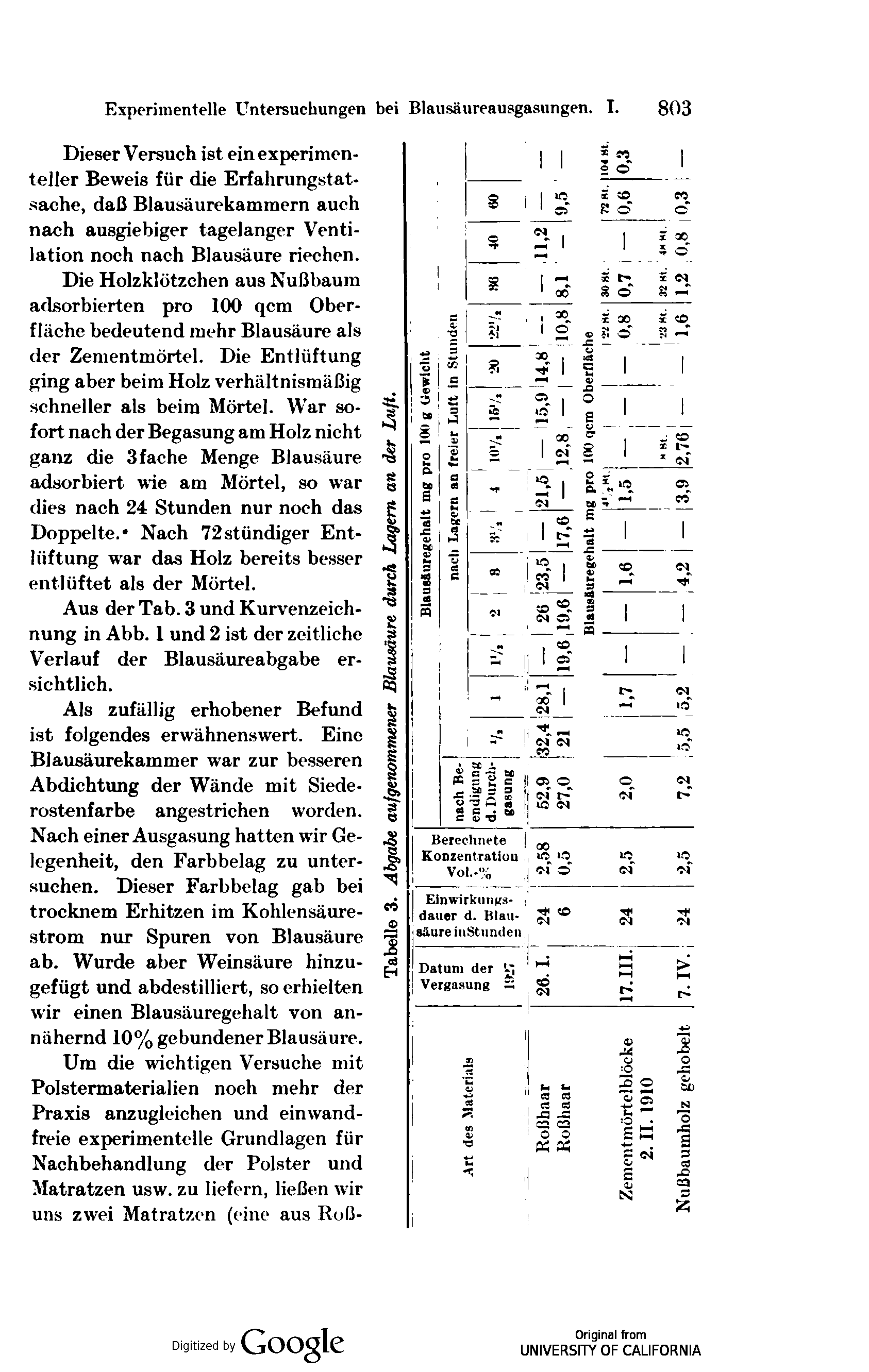
English translation of the relevant passage
The following finding, obtained by chance, is also worth mentioning. In a hydrogen-cyanide chamber, the walls had been painted with paint to improve the seal. After a fumigation we had an opportunity to examine the coating. On dry heating in a carbon-dioxide stream, this coating gave off only traces of hydrogen cyanide. But when tartaric acid was added and the material distilled, we obtained a hydrogen-cyanide content of approximately 10% bound hydrogen cyanide.
This is the relevant paragraph. The paint name is unclear in this reading, so no composition is assigned to it. The experiment didn’t establish a whole-wall retention percentage.
There’s no factor-of-100 transcription error in the four Part I rows marked in Rudolf’s Table 7. The original values of 48, 5.4, 1.4, and 15.5 mg per 100 cm² become 4,800, 540, 140, and 1,550 mg/m². Fresh lime mortar exceeded fresh cement mortar in that test, and Rudolf printed both results and discussed the difficulty of interpreting them. The measured ordering is real; neither a universal cement advantage nor a universal lime advantage in lasting pigment follows from it. Part I, page 801; Part II, page 201.
Rudolf’s own mortar tests measured retained cyanide
R27 and R28 gave 109 and 94 mg CN/kg after fumigation and storage. That is a much smaller contrast than eight, but it isn’t a dry-versus-wet test of the same specimen. Rudolf’s 2020 Table 32 lists added water for R27; it also prints lime in R27’s recipe and chalk in R28’s. His discussion distinguishes additionally moistened specimens from specimens already moist by nature. The pair establishes positive retained cyanide in his cement samples. It neither verifies an eightfold moisture multiplier nor cleanly disproves one. Rudolf 2020, page 328; results on page 311.
Rudolf also points to high cyanide levels inside delousing walls he describes as warm and dry. That observation rules out a simple claim that lasting cyanide requires persistently wet walls. It doesn't measure an eightfold wet-to-dry effect under otherwise matched conditions. He distinguishes those samples from the low readings in walls added during the later conversion to hot-air disinfestation. Any account of the residue contrast must preserve the substantial delousing inventory rather than explain it away. Rudolf 2003, page 263.
The cement factor isn’t established for these walls
Rudolf's cement factor has a laboratory basis. On p. 268 he reports roughly twice as much retained cyanide in his cement pieces as in his lime pieces; the four results give a ratio of 1.83. On p. 283 he extends the argument to the walls: "Quantification in this regard is difficult, but a factor in excess of two must be anticipated." He points to cement mortar's "longer-lasting alkaline properties" and "greater specific inner surface area," and on p. 268 to the cement pieces' greater iron content, "since the cyanide content increases proportionally to the iron content." Those observations support his comparison. Four pieces, each tested once, don't establish a minimum factor for the historical walls under different exposure histories. Rudolf 2003, page 268.
His uptake table also reports 4,800 mg/m² for fresh lime mortar, against 540 for fresh cement mortar and 140 for month-old cement mortar. He reads that table as favoring cement over brick and fresh cement over aged cement, and calls the concrete-block result difficult to interpret. Those are his claims on that page. The fresh lime and cement results prevent a blanket ranking of cement above lime even for temporary uptake; they don't establish the reverse ranking for lasting pigment. The table also warns that its stated gas concentrations were theoretical nominal values, reached in practice only up to 50% or less. That warning doesn't quantify an error in the moisture ratio. Page 187, Table 7 and its notes.
On p. 272 of the 2003 edition, Rudolf says the Kraków test confirmed at least tenfold greater uptake by moist cement mortar than dry lime mortar. The original table pairs wet and dry specimens of one mortar and names neither cement nor lime. It doesn’t establish the combined material-and-moisture comparison he attributes to it. Rudolf and Kollerstrom later reanalyzed the Auschwitz wall samples, not the four laboratory pieces, so their repeat tests neither confirm nor overturn the 1.83.
The exposure factor depends on a schedule
The 2 to 19 factor depends on the assumed gas concentration and schedule. Rudolf gives both rooms 10 grams of hydrogen cyanide per cubic meter and calculates wall saturation from equivalent periods of constant concentration. On page 284 he expressly allows for gas concentration falling through leakage and uptake. His six- and twelve-hour delousing rows stand in for operation described as roughly round the clock. They aren't claims that each actual treatment lasted only six or twelve hours. No recovered BW 5 operating log establishes those equivalent exposures. Farber's, Amann's and Rablin's accounts of day-long treatment don't settle the conversion either: elapsed time under gas doesn't establish a constant gas concentration throughout it. Rudolf 2020, page 284.
Ventilation inputs and the six-hour versus twelve-hour schedule
In the 2020 edition he names his two morgue airing inputs as 72 and 14.4 minutes of equivalent constant contact, selects them as one twentieth and one hundredth of a day, and points specifically to column 6 of Table 20 and column 5 of Table 21. Neither equivalent duration appears there as a printed result, and he gives no averaging or rounding calculation that produces it.
The ventilation model behind them, laid out on p. 223 of the 2003 edition, starts from the installed fan of 4,800 cubic meters an hour, which would change the 430 cubic meters of free air "once in approximately 5-6 minutes," and then multiplies the time "by a factor two to four or more" for the air short circuit alone. He also allows for bodies obstructing airflow and gas continuing to leave the pellets. The cited sources supply no test measuring those effects together in that cellar.
The 2020 edition also gives two different masses of Zyklon B for the same ventilation simulation. The body text on p. 281 uses 14.2 kilograms, footnote 350 defines its equation with 14.2 as well, and the same footnote says on p. 282 that "for the sake of simplicity, I have used 20 kg." The printed table reproduces from 14.2. The 20 has a source in his own earlier book. On p. 224 of the 2003 edition the Graph 15 scenario runs the same cellar on approximately 20 kilograms of Zyklon B. Using 20 would lengthen the airing and help his objection, so the defect is an unresolved conflict on his page, not a hidden input.
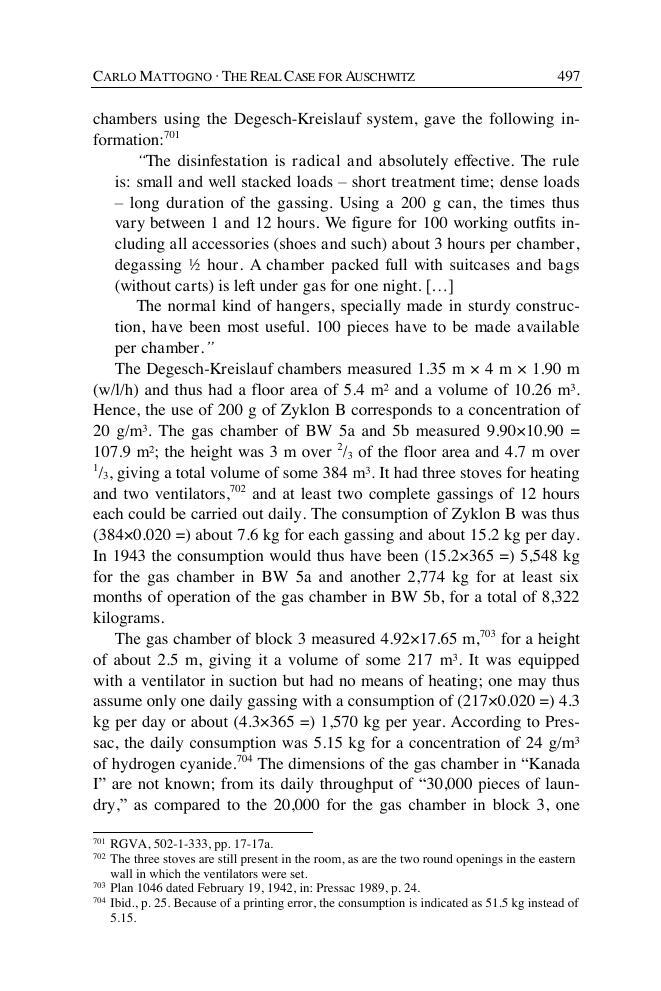
Rudolf's co-author Carlo Mattogno models BW 5a and 5b using twelve-hour treatments. On pp. 496–497 of The Real Case for Auschwitz, he first quotes a July 4, 1944 Weimar construction-office letter about small DEGESCH circulation chambers. It gives a range of "between 1 and 12 hours," about three hours plus half an hour of degassing for 100 working outfits, and overnight treatment for a chamber packed with suitcases and bags. Mattogno distinguishes those 10.26 m³ chambers from the roughly 384 m³ BW 5 rooms. For BW 5 he then assumes "at least two complete gassings of 12 hours each could be carried out daily," using "about 7.6 kg for each gassing and about 15.2 kg per day," or 5,548 kilograms in 1943 for BW 5a alone. The letter doesn't establish a three-hour or twelve-hour operating schedule for BW 5. Mattogno 2019, page 497.
Rudolf rejects his twelve-hour constant-concentration row because sustaining it, he says, would require 24 to 30 kilograms a day, roughly the camp's whole annual delivery, "leaving no HCN for homicidal gassings." Mattogno's two actual twelve-hour treatments aren't the same input as twelve hours at a fixed gas concentration. His reconstruction therefore doesn't establish the replacement row. As a sensitivity test, substituting Rudolf's twelve-hour row for his six-hour row reduces the corresponding chamber-to-delousing ratios by about 46 percent, with the other factors unchanged. That arithmetic tests the model's dependence on its inputs; it doesn't recover the historical schedule. Table 22, page 285.
Correcting the arithmetic helps Rudolf
Sixteen divided by nineteen is about 0.84, not the 0.4 the 2003 edition prints, and the 2020 edition gives 0.8. The correction raises the low end of Rudolf's prediction and strengthens his argument.
Take Rudolf's twelve-hour row instead of the six-hour row, and both ends of the range fall by about 46 percent. Take the 5.22 moisture contrast from the other row of the same Schwarz and Deckert table, and the range falls by about 35 percent instead. Take his own 1.83 for the cement factor instead of 2, and it falls by 8.5 percent, while both nearby numbers together cut the range by about 40 percent. Each swap is taken against his printed range, not stacked on the one before it. None closes the gap between his prediction and his readings. These changes show how the range depends on his choice of inputs; it isn't a measured uncertainty range from matched walls.
Rudolf’s own conclusion retains a carbon-dioxide exception
On pp. 358–359 of the 2020 edition, Rudolf calls the influence of carbon dioxide on lasting cyanide compounds unclear. He argues that cement carbonates slowly and can therefore keep binding HCN for a long time. He also says it seems unlikely that carbon dioxide explains the enormous observed gap. Those are his reasons for expecting high residues. Yet his conclusion still makes an explicit exception if carbon dioxide sharply reduces cement’s ability to bind cyanide irreversibly.
That exception matters because it concerns the quantity he is trying to predict. Slow carbonation doesn’t itself put a numerical lower bound on the final binding yield under the proposed chamber conditions. The Kraków experiments also show that the effect changed direction with the material, as the original results below demonstrate. They don’t supply a universal reduction factor, and this dossier doesn’t use one. Rudolf’s own conditional comparison can’t establish the unconditional exclusion he later states.
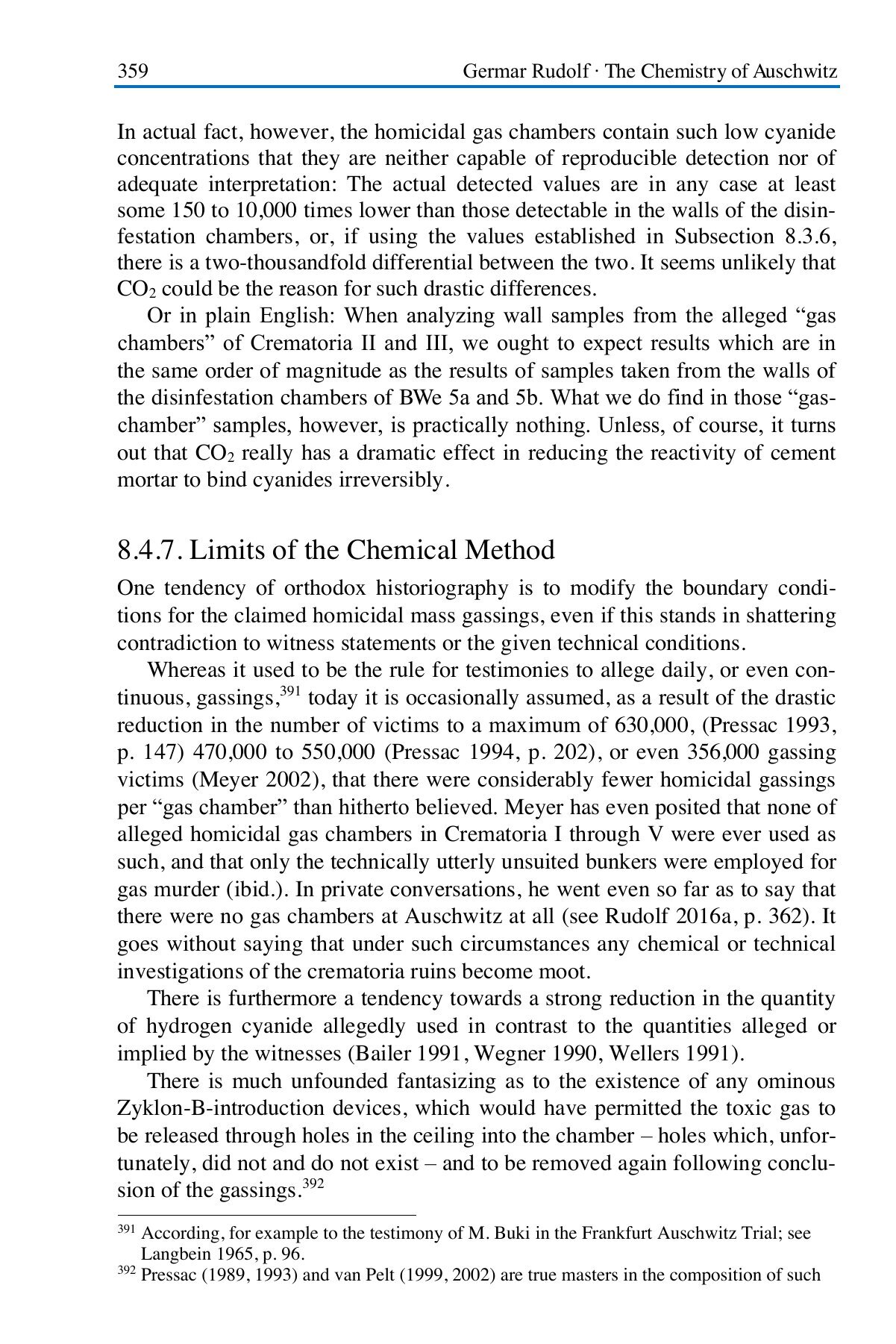
Read the preceding page, including the complete factor list and slow-carbonation argument.
Rudolf acknowledges the missing tests
On p. 284 of the 2003 edition he writes that it is "not inconceivable" that the morgue masonry "was not, or more slightly, inclined to the formation of Iron Blue, or that possible residues were destroyed for unknown reasons," and that no empirical data were available for his assumptions. On p. 360 of the 2020 edition he calls those assumptions "generally well-founded" but "not infallible," says prediction with certainty is "impossible," and states that his conclusions "under no circumstances do they constitute confirmed truth." He adds that better prediction would have required an extensive series of tests he lacked the time, equipment and money to run. Five pages later he writes that the gassings "cannot have taken place as claimed by witnesses." No wall test appears between the two sentences.
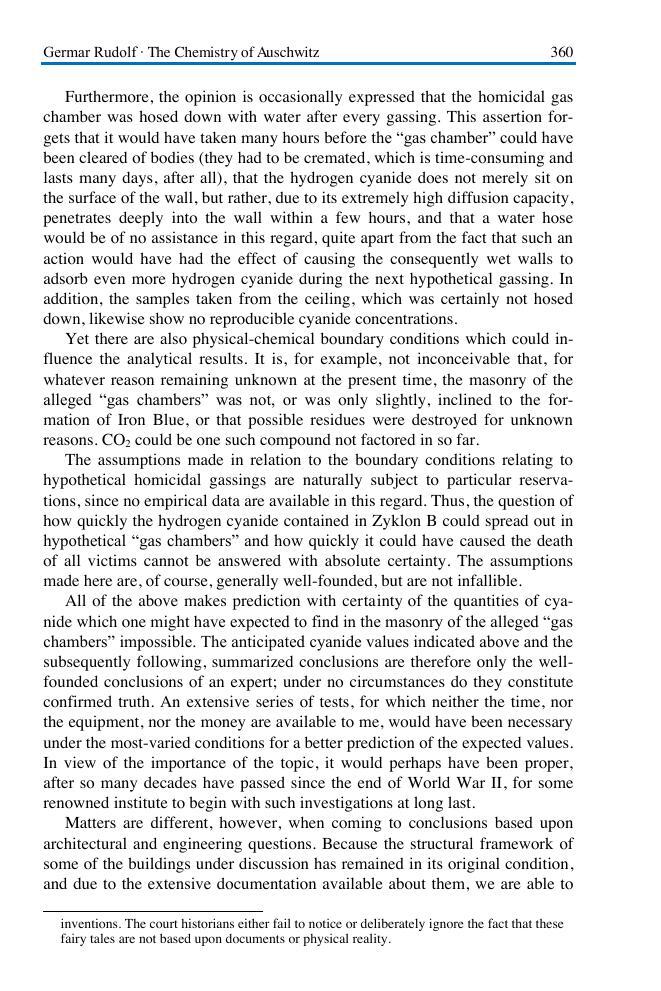
The separate uptake-and-capture calculation tests the missing chemical step. Its near-match remains conditional on the jointly valid wall conditions described there.
Rudolf hasn’t established a chemical exclusion
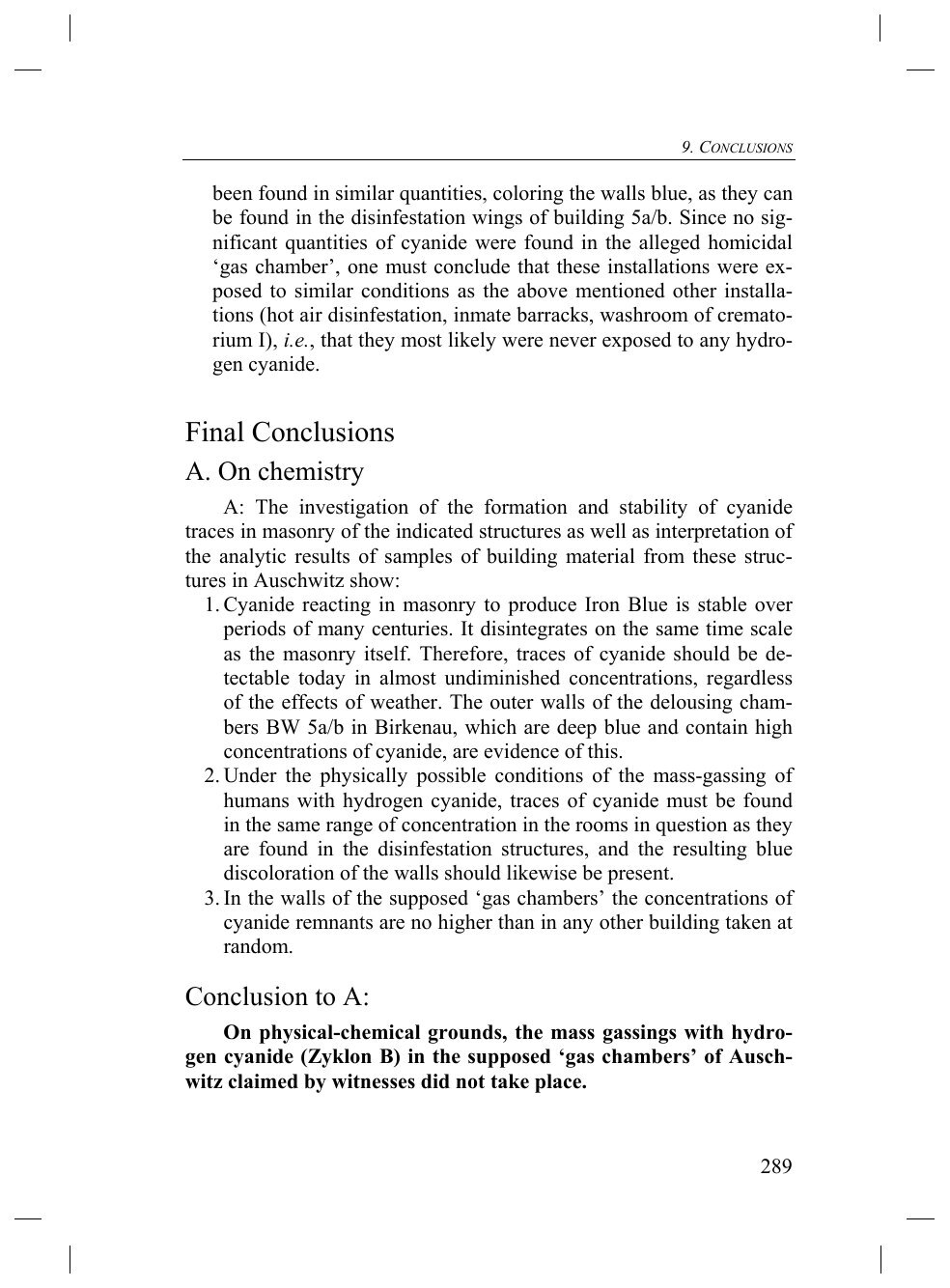
The verdict is the bold sentence on p. 289, that "on physical-chemical grounds, the mass gassings with hydrogen cyanide (Zyklon B) in the supposed 'gas chambers' of Auschwitz claimed by witnesses did not take place."
Even granting Rudolf his numerical moisture, cement, and exposure factors, he still needs to establish that their product bounds the lasting cyanide recovered from the compared samples. The uptake test doesn’t establish that relation. His arguments about favorable chemistry attempt to bridge the difference, but don’t quantify it. His later edition also retains an explicit exception for an effect on irreversible binding whose size he hasn’t bounded.
The nonlinear calculation demonstrates that low chamber residue and high delousing residue can coexist mathematically while every captured product remains. Establishing a physical counterexample requires those reaction, transport, and material assumptions to hold together. That work isn't completed by selecting a favorable numerical row.
Uncertainty among small assay values doesn’t erase the broad residue gap. Positive cyanide detections in the crematoria remain evidence, while an assay that excludes Prussian blue can’t settle why that pigment differs between the rooms. Stable pigment can survive for decades, including below a surface layer. The failure is the leap from those true observations to a necessary high chamber residue. Rudolf hasn’t established that necessity. The residue comparison therefore doesn’t support his claim that the killings were chemically impossible.
Uptake and lasting retention are different events
Of the uptake measurements he reprints, Rudolf writes that the method "measures only the amount of hydrogen cyanide released by the samples after their exposure to HCN. Hence this method cannot establish any possible long-term physical or chemical binding of hydrogen cyanide in the samples" (2011 edition, p. 176; 2020 edition, p. 224).
The experiments Rudolf presents show why exposure cannot simply be equated with lasting residue. In the 1929 data he reprints (2020 edition, p. 224, Table 9), well-dried cement mortar exposed for 24 hours yielded 200 milligrams of recoverable hydrogen cyanide per square meter at the end of exposure and 80 after 22 hours of airing; concrete described as still somewhat fresh yielded 5,198 at the end, 2,209 at 22 hours, 1,835 at 66 and 1,926 at 90 hours. Both things are in that table. During airing, much less HCN became recoverable from these specimens, while the fresher concrete still yielded a substantial amount after several days. The table does not identify every remaining compound or say how much of the decrease was escape rather than conversion into less recoverable forms, which is the point of Rudolf's own sentence above.
His own mortar test, examined below under exposure without visible blue staining, points the same way. After 24.75 hours at 2 percent hydrogen cyanide by volume and 71 days of dry storage (2011 edition, p. 251), his cement mortars held 109 and 94 milligrams of cyanide per kilogram (p. 240, Table 20), and he writes that drying "strongly hindered the conversion to iron cyanide" (p. 252) and that "the dry storage of the samples probably blocked the conversion process" (p. 253). A retained-cyanide measurement does not identify the pigment fraction. Nor does a positive cyanide result require a visible stain.
The Kraków pilot tests add the operational side. In the HCN-only series, 48 hours of fumigation at about 2 percent was followed by 48 hours of airing before the first analysis (Markiewicz, Gubała and Łabędź 1994, p. 21). The procedure then recovered between no detectable cyanide and 2.7 milligrams per kilogram (p. 25, Table V). The paper reports a mean decrease of 56 percent over a month in that series and 73 percent in the series with added carbon dioxide; some later determinations used replacement pieces from the same larger lumps (p. 25). A separate washing test reduced the recoverable fraction by 82.5 and 90.7 percent when two half-gram plaster samples were each flushed with a liter of water (p. 26, Table VII). Those are measurements of a recoverable fraction under laboratory conditions, not of pigment destruction and not of an intact wall.
What a conserving wall model can and can't show
When the morgue walls are tested, Rudolf writes, "we ought to expect results which are in the same order of magnitude as the results of samples taken from the walls of the delousing chambers" (2003 edition, p. 283).
Ventilation limits the supply of gas to the wall. It does not itself stop the chemistry inside it. Rudolf's calculation distinguishes a 14.4-minute equivalent exposure from a 72-minute one (2020 edition, pp. 284 to 286), and his mechanism allows iron(II)-cyanide to accumulate in strongly alkaline masonry "waiting for the pH value to drop" (2011 edition, p. 150). Both belong in any honest account, and both are in ours.
The calculation page sets out a wall model that tracks mobile cyanide, captured product and escaped cyanide. Calibrated to Rudolf's mortar endpoint and run on his own two exposure branches, it can produce low morgue residue and high delousing residue on his short branch under stated assumptions, and it does not reproduce the low and high pattern in any tested 72-minute case. Seven checked variants of the capture law give morgue outputs from 8.18 to 551.93 milligrams per kilogram under the same schedules. A sweep of 133 combinations of capture exponent and mobile capacity reproduces the pattern (morgue at or below 60 milligrams per kilogram, delousing at or above 1,000) at 54 of 133 points for the 14.4-minute branch, 24 for a 30-minute branch, and none for the 72-minute branch. Within this family the pattern needs a capture exponent of about 1.5 or more. Those fractions describe the model's sensitivity to its own assumptions; they are not probabilities, and the grid is not a likelihood.
The result depends on a capture law motivated by solution experiments, exchange times borrowed from other specimens, an assumed mobile capacity, an unverified relationship between the two materials, and assumed gas-concentration histories and treatment schedules. The model replaces Rudolf's material factors with one shared response scaled by total iron, so R12 and R13 are scaled outputs of a single calculation, not independent depth-profile predictions. The displayed variant was chosen after the grid had been seen, so its agreement with the measurements is not an independent test. Calibration to one laboratory endpoint does not validate the family. A linear capture law, by contrast, gives a delousing-to-morgue ratio of about 21 against the observed initial ratio of about 433, so brief exposure alone does not produce the contrast within this model; the differential capture does. Replacing the common reacting pool with separate capture in the two exchange contributions and recalibrating gives 4.53, 2,260 and 2,393 milligrams per kilogram for the morgue, R12 and R13; the pattern survives that structural change, which tests one sensitivity and does not establish the real transport behavior.
Within the model, low morgue residue and high delousing residue coexist even though mobile cyanide carries over between exposures and captured product is never destroyed. It does not show that these walls behaved that way. The measured gap is compatible with mechanisms Rudolf's numerical bound does not establish or exclude.
Chemical and historical constraints
Why the delousing walls are blue
Rudolf's comparison depends on Iron Blue. Hydrogen cyanide meets iron in damp masonry and forms a pigment stable for centuries, and the blue delousing walls prove it happens in camp buildings.
The blue is a pigment called Iron Blue, better known as Prussian Blue, and it forms when cyanide in water meets iron in the wall under the right conditions. Rudolf's own chemistry chapter lays out what "the right conditions" means. On p. 160 he organizes pigment formation into five steps. The gas has to be taken up by the wall. It has to dissolve in water and split into cyanide ions, because only the ion can form the complex. Iron in the wall has to be present, and part of it has to be reduced to the divalent form. Once that has happened, Rudolf says, the combination into the pigment "occurs spontaneously and completely," so the earlier steps determine whether the pigment forms. He names those conditions nine pages later.
His Table 4 on p. 169 lists those conditions, and the first line is water. In his words, increasing water content gives "increased absorption of hydrogen cyanide," "long-term retention of ad-/absorbed hydrogen cyanide," "increased mobility of reaction partners," "increased reactivity of iron oxide," and water is "the basic precondition for disassociation and redox reactions." Two pages later, on p. 171, he gives the other limit. Fresh mortar and concrete are strongly alkaline, and in his words, "The pH range around 10 to 11 can be considered the critical limit for the stability of Iron Blue." A footnote reports Degussa, the pigment's maker, rating its lime fastness "not good" in still uncarbonated, alkaline plasters and concretes. Inside BW 5b the walls are "mostly white," with pale green stains "visible only in a few places," and on p. 265 Rudolf explains the missing blue by an "iron-poor lime plaster" with too little iron to form the pigment. He adds that "even the upper layer of plaster exhibits quite high cyanide values." Rudolf didn't measure the pH of a Morgue 1 wall during its use, and no modern reading of the rubble can supply that wartime value.
Blue also isn't a gauge of how much cyanide a wall holds. His highest reading, 13,500 milligrams per kilogram, came from Sample 17, plaster that was only greenish under a mostly white surface, and he writes on p. 264 that "The color of the material, here only greenish, is apparently not directly meaningful with regards to the cyanide concentration."
The Kraków institute's Table IV does hold one pair where color and cyanide tracked, dark-blue plaster at 840, 792 and 840 micrograms per kilogram against white-wall plaster at 28, 28 and 28, and that pair runs in his favor.
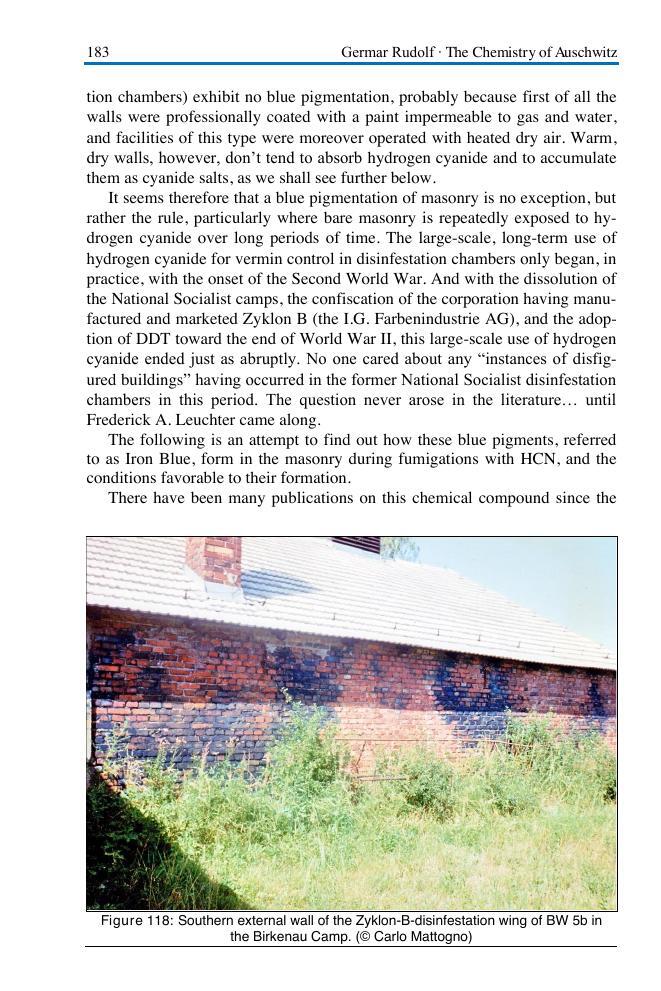
In August 1976 a Protestant church at Meeder-Wiesenfeld was fumigated with Zyklon B against woodworm in the choir stalls, a few weeks after it had been replastered with a water-resistant cement mortar, and in the spring and summer of 1977 huge blue stains were found across the plastered interior. Rudolf returns to it as the analogy for a cool, damp, freshly cemented cellar. He discusses how often this happens on p. 152. In "the many hundreds of thousands of fumigations which have been carried out since 1920" such damage can't have been usual, so "the case in question was, therefore, an exception." His church pages identify the fresh, damp plaster as the cause. By the 2020 edition the sentence reads "The cases in question were, therefore, exceptions," and on the next page he states the other side of the same rule: "It seems therefore that a blue pigmentation of masonry is no exception, but rather the rule, particularly where bare masonry is repeatedly exposed to hydrogen cyanide over long periods of time." That rule applies to bare masonry given repeated, long exposure, which is what a delousing room gave its walls.
Exposure without visible blue staining
A smaller dose, he says, would still have made blue, because the morgue was cool, damp and freshly cemented, the same conditions as the church.
Rudolf conditioned fresh Portland cement and lime mortars for about five weeks at 11 °C and 90 percent humidity, exposed them to 2 percent hydrogen cyanide for nearly 25 hours, and stored them for 71 days. The cement pieces then gave 109 and 94 milligrams of cyanide per kilogram, the lime pieces 53 and 58. On p. 268 of the 2003 edition (p. 253 in the 2011 edition) he writes: "Blue pigmentation of the samples was not to be expected," because even if all the bound cyanide were Iron Blue it would make up only 0.005 to 0.01 percent of the material, "which would cause hardly any perceptible coloration to the naked eye," and because "the dry storage of the samples probably blocked the conversion process." He also writes that added moisture produced only a slightly perceptible rise in hydrogen cyanide absorption because the samples were all very moist and later dried out. The retained-cyanide results differ little, but all specimens were moist; this wasn’t a dry-versus-wet test of the eightfold factor. The cement mortars also had different admixtures as printed in the 2020 preparation table. Dry storage keeps the experiment from reproducing the morgue. His retained-cyanide results don't establish visible blue as a necessary outcome of gas exposure. His quoted percentage also needs a mass conversion: 53–109 mg CN/kg would be about 0.01–0.02 percent ideal anhydrous Prussian blue if all that cyanide belonged to it. Hydration or a different pigment composition would change the conversion. Neither percentage supplies a measured visual-detection threshold.
Rudolf chose Wiesenfeld because its cool, humid walls and young cement plaster looked like the conditions he assigns to Morgue 1. Wiesenfeld shows that visible blue can follow a single Zyklon B fumigation of fresh, damp cement plaster, but it supplies no minimum time and doesn't prove that another wall had to turn blue.
The stains appeared in the spring and summer after the August 1976 fumigation, a span the Kraków institute's January 24, 1995 fax summarized as "nearly a year" (Auschwitz Lies, p. 58). Rudolf's "approximately two years" is his proposed completion of the change into stable Iron Blue, not the first visible staining, and he allows that the paler prior stage "could already have been completed or well progressed prior to this." Neither span establishes that blue staining had to appear during Krematorium II's twenty-two months of standing or Krematorium III's nineteen.
Rudolf's faster result came from iron hydroxides attached to wet paper strips, which showed visible blue "after a few minutes" at pH 7 to 9 and no blue after thirty minutes at pH 2 to 3. Wet paper already holds iron and water where the gas reaches it, unlike plaster, mortar, concrete or a wall.
The same church in two different accounts
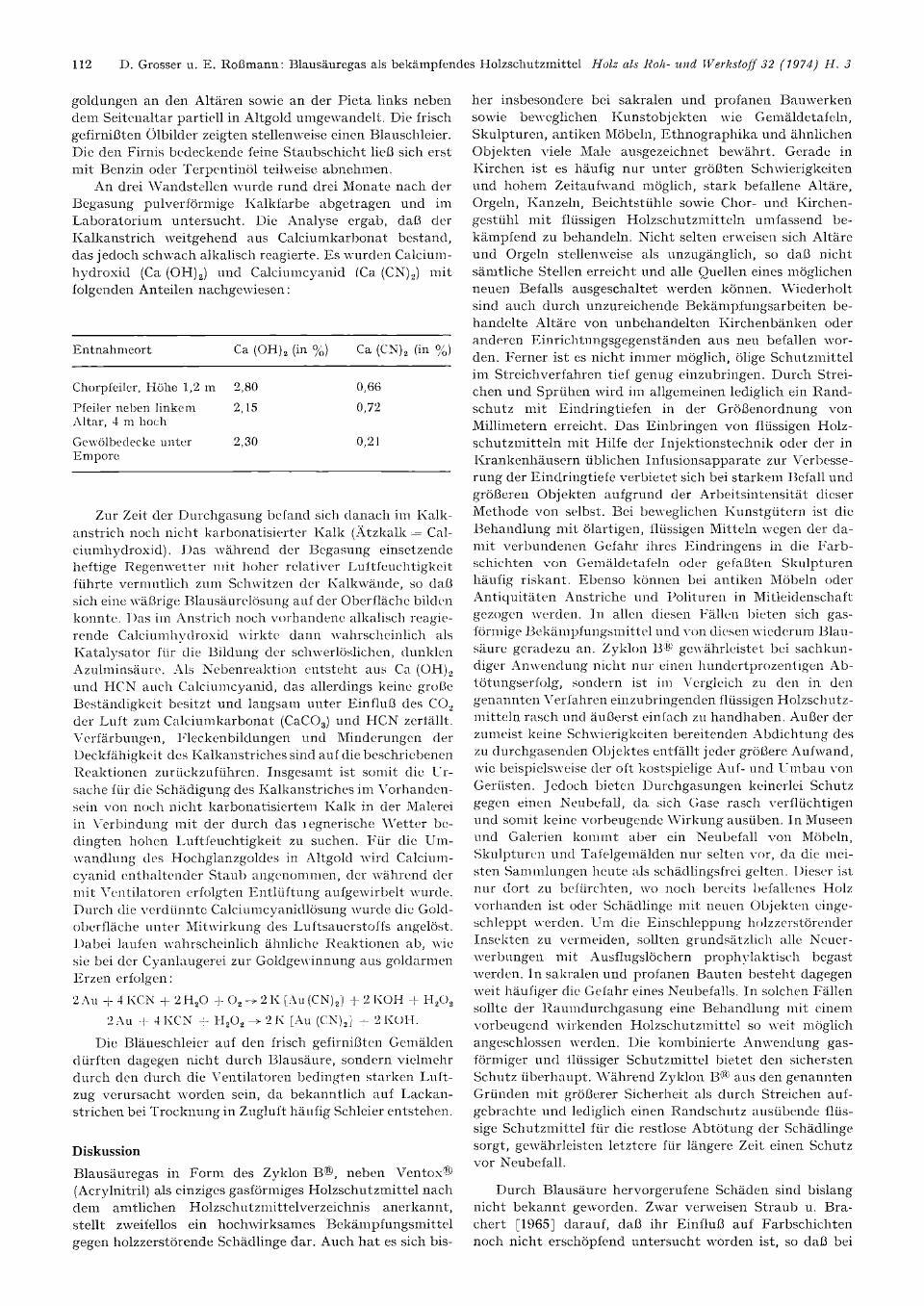
Rudolf gives two materially different accounts of what is, in all likelihood, one church, St. Michael in Untergriesbach. He names it in the first account, leaves it unnamed in the second, and never connects them. On p. 28 of the 2020 edition, citing a parish newsletter, he says its fresh plaster turned blue after it was gassed in 1972, and his caption on p. 27 says the entire plaster turned patchy blue. On p. 29 he writes that in other cases "there was also damage to the structure and interior installations, but no blue stains, perhaps because the plaster was old and had already set," and footnote 18 cites Grosser and Roßmann for a church "freshly painted with iron-free lime paint" that showed "dark stains caused by the polymerization of hydrogen cyanide."
The description closely matches the paper's detailed case, the Untergriesbach fumigation of July 1972: a fresh lime and casein coat whose lime was still uncarbonated, heavy rain and condensation during the fumigation, and dark staining the authors attribute to polymerized cyanide. The paper never calls the lime iron-free. It reports yellowing, spotting, reduced covering power, calcium hydroxide and calcium cyanide in the lime coat, and, cautiously, dark and sparingly soluble azulmic material. It identifies no Prussian Blue in the plaster. The one blue it records is a haze on freshly varnished oil paintings, which the authors credit to the ventilation fans rather than the gas.
That doesn't prove blue was absent, but it leaves Rudolf's blue-plaster account unconfirmed by the report he cites. Kochel am See, which the paper mentions as a smaller case three months earlier, is the only reason not to call the match certain. Either way, his old-plaster explanation points to a paper about fresh lime that hadn't finished curing.
A second parish church, at Thundorf, was fumigated in the same month with the same lime, casein and fresco paints on a coat only fourteen days old, and showed no damage worth naming beyond one small yellow patch. The authors credit the sunny, dry weather that let no condensation form. They also record a lime and casein coat on an exterior facade that was only half carbonated after eighteen months. Fresh lime isn't the damp cement mortar Rudolf assigns to Morgue 1, but both stand opposite the old, set plaster his explanation needs.
Dachau and Buchenwald are exceptions in his own account
Rudolf accepts Zyklon B use without blue staining in these delousing chambers. To infer that another room wasn't exposed, he needs a supported comparison of its wall conditions and a prediction for those conditions. Visible staining and measured total cyanide are different questions. His account gives no total-cyanide measurements for these rooms to compare with the Auschwitz samples.
On p. 152 Rudolf writes: "To my knowledge, only the Zyklon B disinfestation chambers of Dachau camp (DEGESCH circulation chambers) exhibit no blue pigmentation, because the walls were professionally coated with a paint impermeable to gas and water." There is no footnote on that sentence. Dachau's chambers used Zyklon B and aren't blue, so Rudolf's rule needs an exception for them, and the exception is a wall coat he doesn't source. In the 2020 edition he adds Buchenwald, softens the sentence to "probably because," adds heated dry air, and still cites nothing for the coat. The DEGESCH design paper he cites for that chamber type gives the door seals, heating and fan, but no wall coat for Dachau or Buchenwald. Schwarz and Deckert did find that three coats of asphalt lacquer cut hydrogen cyanide uptake from 4,096 to 58.6 milligrams per square meter. That experiment shows how a coating can limit uptake. It doesn't establish that either chamber had such a coating.
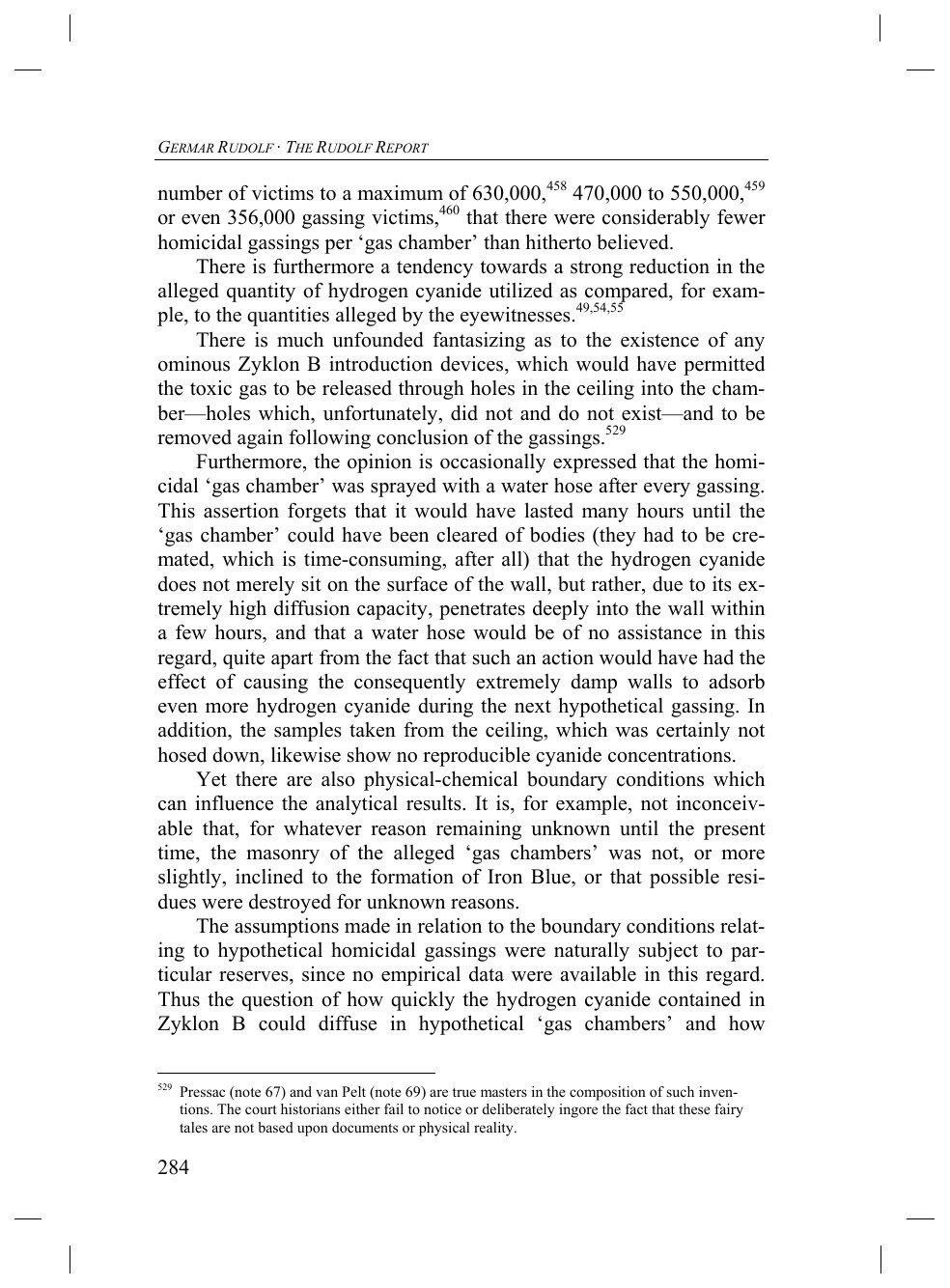
People breathe out carbon dioxide, a difference between a room full of people and a room full of clothing. On p. 165 Rudolf argues that hydrogen cyanide is about 250 times more soluble in water than carbon dioxide and that carbon dioxide "is hardly converted into carbonic acid in water at all," so "this influence may be disregarded."
The Kraków researchers deliberately added carbon dioxide during the gas exposure. They exposed building-material pieces to hydrogen cyanide alone in one series and to hydrogen cyanide mixed with carbon dioxide in another. This wasn't just exposure to atmospheric CO₂ during storage. Nor was it a reconstruction of CO₂ building up through breathing in an occupied chamber.
The researchers added CO₂ during exposure
Gas exposure
48 hours
HCN alone, or HCN with added CO₂.
About 2% HCN; CO₂ to HCN at 5:1 in the second series.
First measurement
After 48 hours of airing
The samples had left the gas exposure and were aired in open air.
Repeat measurement
One month later
Mean loss during further airing
- HCN only
- 56%
- HCN + CO₂
- 73%
At the first measurement, wetted fresh mortar gave 2,700 micrograms of cyanide per kilogram after HCN alone and 388 with CO₂ added. Wetted fresh plaster gave 480 and 12,800 respectively. The change wasn't uniformly downward. These results don't give a universal reduction factor for historical walls. The pieces came from the institute's renovation, and the exposures took place at about 20°C. The method didn't measure Prussian blue.
Read the carbon dioxide measurements
| Material | Condition | HCN only | HCN + CO₂ |
|---|---|---|---|
| Fresh plaster | Dry | 24 | 5,920 |
| Fresh plaster | Wetted | 480 | 12,800 |
| Fresh mortar | Dry | 176 | 492 |
| Fresh mortar | Wetted | 2,700 | 388 |
| New brick | Dry | 4 | 52 |
| New brick | Wetted | 52 | 36 |
| Old brick | Dry | 20 | 24 |
| Old brick | Wetted | 0 | 60 |
| Old mortar | Dry | Not reported | 1,000 |
| Old mortar | Wetted | Not reported | 244 |
In the 2020 edition Rudolf's Table 38 prints carbon dioxide factors of 247 for fresh dry plaster, 27 for fresh moist plaster, 3 for fresh dry mortar and 0.14 for fresh moist mortar. He argues conditionally that the results would support his material contrast, while also objecting that carbonate interference could have caused false positives. His table labels the 0.024 mg/kg dry-plaster starting value "ND" under his proposed 0.2 mg/kg threshold. The original study reports it as 24 micrograms per kilogram, above its stated 3 to 4 micrograms per kilogram detection threshold. The nondetection label is Rudolf's, not the laboratory's. His threshold objection is examined in the section on the two laboratories.
During a subsequent month of airing, the authors reported mean losses of 56 percent for the hydrogen-cyanide-only series and 73 percent for the series with carbon dioxide. The 73 percent describes loss within that second series over time. It isn't the percentage by which adding carbon dioxide reduced the measured residue. The authors also warn that some later assays used different fragments from the same larger pieces, which limits the comparison.
The residue calculation doesn't explicitly model carbon dioxide, changes in pH caused by it, or washing. None of the percentages in these experiments has been applied as a reduction factor in that calculation.
Rudolf cites Green and McCarthy as agreeing with him. In their 1999 reply they wrote that "supposing that Rudolf is correct or nearly correct regarding the formation of blue staining in the delousing chambers, it is exceedingly unlikely that the same process would have taken place to any great extent in the gas chambers used for mass murder," and that "Prussian blue is not a good marker for exposure to hydrogen cyanide." The first sentence is conditional, not an agreement.
Washing, weathering, and surviving residues
Iron Blue is stable for centuries, Rudolf argues, so cyanide that entered the morgue walls in 1943 should be detectable today, "regardless of the effects of weather."
Rudolf's stability claim concerns finished pigment. His three-zone account allows cyanide to accumulate in other forms before Prussian blue develops in less alkaline, carbonated material. That distinction prevents pigment stability from becoming a measure of total retained cyanide. It doesn't establish the wartime pH of Morgue 1 or the share of its cyanide present as soluble precursors.
The accounts distinguish washing bodies from cleaning the chamber. Ya'akov Gabai described hosing the bodies after they had been removed, both to clean them before cremation and to make them easier to drag (Gideon Greif, We Wept Without Tears, pp. 195 to 196). Henryk Tauber specifically described a corridor tap and rubber hose used to wash the gas-chamber floor (Pressac, p. 484).
Asked about the color of the chamber walls, Josef Sackar answered that they were the color of concrete and added, "After every killing, we washed everything and sprayed it with a substance so that the odor of the gas would not remain." He then explicitly mentioned washing the floor (Greif, p. 111). Ya'akov Silberberg described cleaning, flushing and airing before another transport, Shlomo Dragon described washing and whitewashing at Bunker 2, and Pressac described equipment for hosing out the Krematoria IV and V chambers. These accounts establish cleaning in several locations. They don't provide a quantitative washing history for the particular walls and ceilings later sampled.
On p. 284 Rudolf argues that clearing the bodies would have taken many hours, during which hydrogen cyanide "penetrates deeply into the wall within a few hours," so a hose "would be of no assistance." He also argues that wetting the walls would increase hydrogen cyanide uptake during the next gassing, and points to samples from a ceiling he says was "certainly not hosed down" but likewise gave no reproducible cyanide. That is his full reply to washing. It addresses penetration, later uptake and an unwashed surface, but supplies no measured comparison of cyanide before and after washing. The net effect of removal and renewed uptake remains unquantified.
The Kraków institute tested washing directly on two half-gram plaster samples, flushing each with a liter of water. The cyanide measured by its assay fell from 160 to 28 and from 1,200 to 112 micrograms per kilogram, losses of 82.5 and 90.7 percent. Its method didn't decompose Prussian blue, so this experiment doesn't measure the loss of that pigment. A liter of water through half a gram of loose plaster also doesn't establish a loss per washing of an intact wall.
Most of the measured cyanide washed out
Each full strip represents the cyanide measured before washing. The dark part remained afterward.
Sample I
160 to 28 µg CN/kg
Sample II
1,200 to 112 µg CN/kg
The delousing building stayed standing and roofed. Morgue 1 of Krematorium II was blown up before the camp was abandoned and has lain open as rubble since. Rudolf's description of his sampling on p. 252 says there were "only a few places in morgue 1" where a pillar had protected the roof and wall from weathering. The samples came from the shallow outer layer, a ceiling sample 0 to 3 millimeters deep and a wall sample 0 to 1.5 centimeters deep.
Rudolf replies that sheltered locations gave readings as low as weather-exposed ones. That weakens an explanation based on rain alone, but doesn't show what a heavily exposed fresh-cement wall yields after washing, carbonation, demolition, weather and shallow sampling. BW 5a proves that stable iron-cyanide residue can last decades on some surfaces. That survival result can't be transferred directly because the two wall systems weren't matched for the compounds that formed, coatings, cleaning, damage or later history, and Rudolf’s own chemistry allows a precursor pool before finished pigment develops. It doesn’t establish the size of that pool in the wartime wall. Why his formation model doesn’t establish the required residue level.
The numerical example doesn’t combine this precursor-loss argument with a low-pH reaction fit. It keeps all captured product and uses no washing, weathering, carbon-dioxide, or assay-loss factor. The question of which reaction law could apply in a carbonating cement wall remains separate.
Claims unsupported by the cited papers
Rudolf's chemistry chapter depends on papers that don't support several claims he assigns to them.
Rudolf combines separate results from Alich, Haworth and Johnson (1967) into one claim of complete conversion. Footnote 338 on p. 160 says the iron complex was completely converted to Prussian blue near pH 10 within 48 hours. The paper's aqueous 48-hour result was conversion between two dissolved iron-cyanide ions, ferricyanide and ferrocyanide. Its blue-product observations followed the addition of iron(III), at pH 9.98 and 10.60. Complete conversion to Prussian blue in two days was a separate experiment in ethanol. The paper supports a route to the pigment, but it doesn't report the single pH-10 experiment with complete pigment conversion that Rudolf attributes to it (Alich, pp. 1638 to 1640).
On p. 171 Rudolf also cites Alich for stability at pH 9 and 10. Observing blue product at those pH values doesn't measure the pH at which prepared pigment dissolves. Rudolf separately cites his own dissolution experiments in footnote 361 for his pH 10 to 11 limit. The Alich citation doesn't establish that limit, and correcting it doesn't by itself disprove the separate experiments he describes.
Rudolf adds blue to Uglow's account of concrete. On p. 188 he reports "dark blue pigmentation" through the entire sample. Uglow described darkening through the concrete and allowed the possibility of chemical combination (p. 115); in his moisture tests the concrete became "entirely black" (p. 117). The uptake comparison is real. Uglow's table gives concrete at 36.28 and old stucco at 9.00 milligrams of HCN per gram, a ratio of 4.03 (p. 114). Those measurements support greater uptake by that concrete. They don't identify the dark material or measure its lasting pigment yield. The added blue supplies an observation the cited passages don't report; black appearance alone doesn't exclude Prussian blue.
Uglow also reported a positive HCN test after heating the exposed material at 200°C for two hours; only stronger direct-flame treatment gave a negative result. Persistent recoverable HCN belongs in the evidence. That test didn’t identify the dark product as Prussian blue or measure a percentage of cyanide retained. The criticism of Rudolf’s added color doesn’t cancel Uglow’s positive chemical observation. Uglow, printed page 122.
El-Sayed, Sayed and Gouda (1981) is cited in footnote 386 on p. 179 as "an interesting study" about "the reduction of soluble components in concrete standing in water" showing that "not even the concentration of alkali ions, which are the most soluble components of concrete, was massively reduced." The paper examines salt entry, corrosion, cracking and early failure at a pumping station. It found normal total alkalinity and generally high sodium oxide, which supports the conclusion that the later alkalinity wasn't abnormally low. But it has no initial values, no matched controls and no before-and-after leaching series, so it can't measure how much soluble material the water removed.
Rudolf misdescribes how the pigment was held in Kape and Mills's weathering panels. On pp. 178 to 179 he calls it "only superficially adsorbed upon the aluminium sheets" and uses that description to call the exposure "considerably more severe" than the conditions affecting masonry. Kape and Mills describe dissolved ions entering the pores of an aluminum-oxide film and forming pigment inside it (p. 364). Rudolf's comparison leaves out that porous film. He needs to establish that it protected the pigment less well than masonry before he can infer the harsher test. Footnote 381 cites both the earlier paper and a 1981 follow-up, so the earlier paper's two-year duration alone doesn't refute his account of a 21-year test.
Rudolf uses a chamber experiment to argue for similar gas losses in an occupied morgue, but the experiment doesn't establish that comparison. Schwarz and Deckert measured reduced gas concentrations in a chamber loaded with upholstered furniture and carpets; they also reported appreciable gas passing through its half-brick side walls (p. 205). Rudolf reproduces the curves in Graph 13 on p. 217. On p. 218 he argues that sweat and uptake through skin and lungs would cause "similar losses," with cold, moist morgue walls adding further losses. The experiment supports gas loss under the conditions tested. It supplies no measured loss for the people and masonry in his morgue calculation.
Peters and Wüstinger (1940) is the DEGESCH paper Rudolf uses on p. 107 to set the ventilation yardstick. He puts the morgue's 9.5 air changes an hour against 72 an hour in a purpose-built clothing chamber. The paper's chamber is a heated ten-cubic-meter box with a twelve-cubic-meter-a-minute fan and internal circulation. A small heated apparatus doesn't set the rate a 504-cubic-meter cellar needed.
The fumigation accidents on pp. 15 to 17 are offered as evidence for how long a room takes to air. They concern houses aired through openings and buildings with no forced-air system. Morgue 1 had a 4,800-cubic-meter-an-hour mechanical system. Those events don't set its airing time.
The gasworks soil on p. 179 is offered as proof that Iron Blue survives for decades outdoors. The soil began with large deposits made during years of gas production. The disputed rooms concern trace cyanide after brief wall contact, followed by washing or weather. Bulk pigment persisting in soil doesn't supply the missing rate for that different exposure.
Claims that change between his pages and editions
Several details the argument relies on change between pages or editions.
The Wiesenfeld church moves from Lower Bavaria in the 2003 edition (p. 20) to Upper Franconia in the 2020 edition (p. 27). The correction doesn't change the chemistry.
The Kraków institute's high delousing readings of 900, 840 and 880 micrograms per kilogram belong to Block 3 in its Table IV. Rudolf's Table 30 on p. 307 of the 2020 edition prints them under "Block no. 1 (disinfestation facility)." Restoring Block 3 puts the high readings back in a known Zyklon room and helps his benchmark. That triplicate is the strongest single sample, not a characteristic Block 3 level. The same Table IV reports two 1990 series from Block 3 that came back much lower, and records no color note for the high sample, so the paper can't say whether that wall was visibly blue.
The Main Camp disinfestation wall is "colored a spotty blue" on p. 152 and, on p. 245, a wall whose interior walls were, "according to the report, painted during the war, so that only a pale blue tint is visible in places." Both sentences are Rudolf reporting the same Polish team under the same two footnotes. A surface layer or a different inspection date could explain the difference. Rudolf doesn't reconcile the two descriptions.
The five-minute evaporation fraction that drives his quantity table is read from a magnified graph in Irmscher (1942) whose tabulated data begin at one hour and were taken at 15 °C and low humidity with the pellets finely spread. Rudolf moves it to a warm, near-saturated room with pellets in bulk in a step he writes "has to remain speculative" (2020 edition, pp. 238 and 268). Irmscher's own page splits at one hour, with the table giving 57 percent of the gas out of the pellets and the graph about 75 percent. Rudolf uses the graph, carries 74.5 percent into his own table, and calls the table's 57 percent an erroneous report of the graph's 75 percent in a footnote. Fit his curve to the table's 57 percent instead and the needed Zyklon B rises to about 94 kilograms; use his separate 30 °C estimate and it falls to about 42. The input that produces his headline number is a five-minute value nobody measured.
Rudolf's Zyklon B supply figures are illustrations that change between editions. In a 1994 chapter he had ordinary delousing consuming about 3.6 tons, close to half the 1942 deliveries. In 2003 the example is 100 cycles a year in each of BW 5a and BW 5b at 4 to 5 kilograms, or 0.8 to 1.0 tons, about a tenth of the same 7,478.6-kilogram total. The cycle count is an example, not an operating log, and it moves by a factor of four. For 1942 it can't stand on Rudolf's own dates. His timeline puts the BW 5a apparatus and sauna in operation from November 1942 and its hydrogen cyanide chamber only after the fall, so it doesn't support a full year of cycles. Mattogno's reconstruction puts a full 1943 year in BW 5a at 5,548 kilograms and at least six months in BW 5b at another 2,774, a total of 8,322.
Rudolf's annual tonnage argument doesn't by itself exclude a shorter interval of intensive use. On page 285 he says the masonry approaches a quasi-constant hydrogen-cyanide concentration after about twenty days or cycles. Twenty days at his own 24 to 30 kilograms a day would use 480 to 600 kilograms. That is arithmetic, not a documented shipment. But periodic gas loading isn't accumulated pigment: reaching that concentration pattern doesn't establish how much lasting residue twenty cycles produced. The actual BW 5 cycle count remains unknown. Rudolf 2020, page 285.
The wet-paper test reverses between editions with the surrounding words unchanged. The 2003 edition says that at pH 2 to 3 "a blue discoloration occurred after 30 min." The 2020 edition says "no blue discoloration after 30 min." Neither page explains the change.
Rudolf expressly assumes the near-limit readings accurate for his comparison. His pooled results then put the homicidal-chamber samples at 1.9 ± 2.4 ppm against controls at 1.9 ± 2.8 and call the difference "nil." The calculation combines different sampled materials, repeated analyses and substituted values for non-detections. Even granting the conditional premise, failure to demonstrate a difference doesn't establish equivalent exposure histories. His next inference is worse. He compares sheltered samples averaging 1.77 ppm with exposed samples averaging 1.32 ppm, calls the difference statistically insignificant, then treats it as a slight decrease over four decades. Those are two groups sampled decades later, not measurements of the same material before and after weathering. This comparison supplies neither starting measurements nor an independent basis for treating the groups as having begun with equal amounts. His comparison can't measure the forty-year loss he draws from it. The conditional premise, page 333 · The comparisons, page 335.
The strongest objections to this account
Rudolf's own qualification is that an "extensive series of tests" would have been necessary for a better prediction, and that little Iron Blue may have formed, or residues may have been destroyed, for reasons he cannot name (2011 edition, pp. 272 to 273; 2020 edition, p. 360).
A competent defender of Rudolf's chemistry has seven replies to the account above. Each is stated here at full strength, with what the evidence answers and what remains open.
- The Kraków signal proves some cyanide, not the exposure history. True. The chemistry corroborates exposure; it does not identify the date, number, duration or purpose of the exposures. Rudolf himself lists a prior disinfestation as one explanation for the crematoria readings (2020 edition, p. 304). Purpose comes from the historical record, not from the assay.
- The model borrows the wrong release behavior. His Table 9 shows fresh concrete holding far more recoverable HCN than dried mortar and still yielding a substantial amount after several days. The model uses exchange times from the dried material. Whether the historical plaster behaved like the dried mortar or like the fresh concrete has not been established, and no total-cyanide endpoint alone can settle it. This is the objection with no current quantitative answer.
- The successful exponent comes from the wrong chemical system. Todd, Wogan and Catling measured dissolved ferrocyanide formation from iron(II) and cyanide in solution over seconds. Their pH 6 data motivate a near-quadratic law; they do not measure gas uptake into cement, mobilization of cement-bound iron, or lasting capture. The effective wall law remains unmeasured. Rejecting the higher-pH fits as confounded does not validate the lower-pH one.
- A common reacting pool may hide the decisive local concentrations. With a nonlinear law, reacting the average concentration is not the same as averaging local rates. The separate-pool variant above shows the pattern surviving one such change; it does not establish the actual spatial behavior.
- The branch and the schedule were chosen. The 72-minute branch fails everywhere on the grid; a 14.4-minute rectangle is not a recovered gas trace; 400 six-hour treatments across 270 days are not an operating log. The short branch is Rudolf's own, not ours, and the internal comparison is legitimate. The historical calibration is incomplete, and equivalent integrated exposures cannot be substituted freely once the chemistry is nonlinear.
- Neither washing nor the church correction supplies the missing pigment. The washing test concerns half-gram pieces and a recoverable fraction. Sheltered ceilings are awkward for any account that leans on water (2020 edition, p. 360). Wiesenfeld remains a relevant single-fumigation case if its technical record bears out Rudolf's description. The model needs none of these loss mechanisms; they are constraints, not the explanation.
- The model does not predict what the two assays separately measure. Correct. A calculation calibrated to total retained cyanide does not by itself predict the Prussian-blue inventory or the fraction the Kraków procedure recovers. The field pattern and the model are compatible strands; their joint chemical accounting has not been demonstrated. Paired total and selective determinations on one characterized material would test it.
What these replies expose is the acknowledged limit of the positive calculation. What they do not supply is Rudolf's missing lower bound. His comparison retains an unquantified carbon-dioxide exception, allows suppressed formation or later loss, and rests on material observations that were never matched experiments establishing the combined multiplier he needs.
What is established and what isn't
The pages establish these things. The Kraków institute recovered cyanide from thirteen of fourteen morgue specimens and none from its eight designated dwelling controls. Rudolf's total-cyanide assay found thousands of milligrams per kilogram in the delousing walls and single digits or nothing in the morgue samples. The uptake data he reprints show both release during airing and retention in fresh material, and his own mortar test retained cyanide without visible blue. His residue comparison prints a relative range whose corrected low end, on his own shortest exposure branch, expects about 2,400 to 2,500 milligrams per kilogram against a measured 6.7 and a retest below detection. His text leaves the carbon-dioxide effect unquantified and allows suppressed formation or later loss.
The model adds a conditional result. Separate capture and escape can reproduce the measured contrast on his short branch without destroying captured product, and cannot on his long branch. The capture law, the exchange times, the mobile capacity, the material relationship and the gas histories have not been established for these walls.
Several questions stay open. The effective wall law, the behavior of fresh cementitious material between exposures, the spatial distribution of reaction, the actual gas and operating histories, the aging of wall-embedded pigment and the joint accounting of the two assays are unresolved. None of those unknowns supplies the bound Rudolf's conclusion requires. His comparison has not established that the gassings he describes must have left a high residue, and the measured gap is compatible with mechanisms his numerical bound does not establish or exclude.
Source list and page references
Sources and page references
Editions and page numbers
Page numbers without an edition refer to Germar Rudolf, The Rudolf Report. Expert Report on Chemical and Technical Aspects of the 'Gas Chambers' of Auschwitz, Theses and Dissertations Press, Chicago, 2003, the 455-page English edition, in which the printed and PDF page numbers agree. Page numbers marked "2011 edition" refer to the 2011 English edition of The Rudolf Report (Theses and Dissertations Press), where printed page N is PDF sheet N+1. For the passages cited most often the editions align as follows: 2003 p. 187 (Table 7 and footnote 410) is 2011 pp. 175 to 176 and 2020 p. 224 (Table 9); 2003 p. 268 (the mortar-test summary) is 2011 p. 253; 2003 p. 283 (the residue formula) is 2011 p. 271 and 2020 p. 358; 2003 p. 289 (the verdict) is 2020 p. 365. The main passages cited from that edition are on pages 16, 21, 97, 107, 152, 160, 165, 169, 171, 177, 178, 179, 187, 188, 192, 193, 202, 215, 216, 217, 223, 245, 246, 247, 251, 252, 268, 270, 272, 282, 283, 284 and 289. Page numbers marked "2020 edition" refer to Germar Rudolf, The Chemistry of Auschwitz, Castle Hill Publishers, 2020, where printed page N is PDF sheet N+1. Pages 27, 28, 29, 119 to 121, 182, 183, 303, 307, 360 and 365 of that edition are reproduced or discussed here. Further 2020 references (pp. 222 to 223, 238, 260, 265 to 268, 281 to 285, 300, 311, 328, 335, 341 to 343, 358 to 359) support the discussions of pigment formation, gas release, ventilation, and laboratory results.
Other works cited
- Germar Rudolf and Nicholas Kollerstrom, "Differential Exposure of Brickwork to Hydrogen Cyanide during World War Two," Inconvenient History 5, no. 1 (2013), pp. 18 to 38, for the repeat and spike tests and the closing methods statement.
- Germar Rudolf, "Critique of Claims Made by Robert Jan van Pelt," April 10, 2000, p. 34, for the rule that results below 10 mg/kg can't be interpreted; the original 1993 English study, pp. 63 to 64, for sample 28; Germar Rudolf writing as Ernst Gauss, "Die 'Gaskammern' von Auschwitz und Majdanek," in Grundlagen zur Zeitgeschichte (1994), p. 385, for the 3.6-ton supply example.
- Germar Rudolf, Lectures on the Holocaust, Castle Hill Publishers, 2014 edition, printed pp. 93 and 488.
- Germar Rudolf, Lectures on the Holocaust, August 2005 edition, p. 249, for the account of Keren and colleagues. Germar Rudolf and Carlo Mattogno, Auschwitz Lies, fourth edition, March 2017, pp. 373 to 407, especially pp. 387 to 388, for the later rebuttal.
- Castle Hill Publishers back matter printed in Carlo Mattogno, Auschwitz: Crematorium I, 2016 printing, pp. 142 and 143.
- Carlo Mattogno, The Real Case for Auschwitz, 2019 printing of the 2015 second edition, printed pp. 57 to 61 and 495 to 497.
- Thomas Dalton, Debating the Holocaust, PDF, printed pp. 224 to 225.
- Germar Rudolf and Carlo Mattogno, Auschwitz Lies, Castle Hill Publishers, 2017 printing, printed pp. 57 to 58, for the Kraków institute's fax of January 24, 1995; The Chemistry of Auschwitz 2020, printed pp. 119 to 121, for the Vergasungskeller reply.
- Daniel Keren, Jamie McCarthy and Harry W. Mazal, "The Ruins of the Gas Chambers: A Forensic Investigation of Crematoriums at Auschwitz I and Auschwitz-Birkenau," Holocaust and Genocide Studies 18, no. 1 (2004), pp. 68 to 103, PDF, printed pp. 75 to 76 and 95.
- John Clive Ball, The Ball Report, Ball Resource Services, Delta, British Columbia, 1993, PDF, printed pp. 10 to 11.
- Carlo Mattogno, "Leichenkeller von Birkenau: Luftschutzräume oder Entwesungskammern?," Vierteljahreshefte für freie Geschichtsforschung 4, no. 2 (2000), pp. 152 to 158, pp. 154, 156 and 157.
- Jan Markiewicz, Wojciech Gubała and Jerzy Łabędź, "A Study of the Cyanide Compounds Content in the Walls of the Gas Chambers in the Former Auschwitz and Birkenau Concentration Camps," Z Zagadnień Nauk Sądowych 30 (1994), pp. 17 to 27, Tables I, III, IV, V and VII, from the printed scan.
- D. Grosser and E. Roßmann, "Blausäuregas als bekämpfendes Holzschutzmittel für Kunstobjekte," Holz als Roh- und Werkstoff 32 (1974), pp. 108 to 114, pages 108, 111, 112 and 113.
- L. Schwarz and W. Deckert, “Experimentelle Untersuchungen bei Blausäureausgasungen,” Zeitschrift für Hygiene und Infektionskrankheiten 107 (1927), pp. 798–813, especially pp. 800, 801, and 803; Part II, volume 109 (1928), pp. 201–211, especially p. 201. Rudolf cites Part II as 1929. Table 7 combines both papers.
- M. A. Alich, D. T. Haworth and M. F. Johnson, Journal of Inorganic and Nuclear Chemistry 29 (1967), pp. 1637 to 1642; W. A. Uglow, Zeitschrift für Hygiene 108 (1928), pp. 108 to 123; H. A. El-Sayed, Cement and Concrete Research 11 (1981), pp. 351 to 362; L. Moggi and colleagues, Journal of Inorganic and Nuclear Chemistry 28 (1966), pp. 2589 to 2598; J. M. Kape and E. C. Mills, Transactions of the Institute of Metal Finishing 35 (1958), pp. 353 to 384; E. Peters and E. Wüstinger, Zeitschrift für hygienische Zoologie 32 (1940); Richard Irmscher, Zeitschrift für hygienische Zoologie und Schädlingsbekämpfung 34 (1942), pp. 35 to 37.
- Jan Markiewicz, Wojciech Gubała and Jerzy Łabędź, method p. 20, standards and repeat analyses p. 21, Table I p. 22, Table III p. 23, Table IV p. 24, Table V and the month-long series p. 25, Table VII p. 26, from the printed scan.
- Bethany L. Todd, Nicholas F. Wogan and David C. Catling, "Kinetics of Ferrocyanide Formation," ACS Earth and Space Chemistry 8 (2024), pp. 221 to 229, Table 1, for the solution rate laws that motivate the capture exponents on the calculation page.
- The sensitivity sweep of the wall model (19 capture exponents, 7 mobile capacities, 3 pulse widths, each combination recalibrated to Rudolf's mortar endpoint) and the separate-pool variant are reproducible from the equations printed on the calculation page.
- Joseph Epstein, "Estimation of Microquantities of Cyanide," Analytical Chemistry 19, no. 4 (1947), pp. 272 to 274, April 1947 issue.
- Richard J. Green and Jamie McCarthy, "Chemistry is Not the Science: Rudolf, Rhetoric and Reduction" (1999), for the conditional sentence and the sentence that Prussian blue is not a good marker for exposure.
- Gideon Greif, We Wept Without Tears, printed pp. 111, 195, 225 to 226, 320 and 323 to 324; Jean-Claude Pressac, Auschwitz: Technique and Operation of the Gas Chambers, 1989, pp. 171, 483 to 484, 494 and 500; The Auschwitz Protocol: The Vrba-Wetzler Report, p. 12; Miklós Nyiszli, Auschwitz: A Doctor's Eyewitness Account, p. 83; Rudolf Höss, Commandant of Auschwitz, p. 222; Filip Müller, Eyewitness Auschwitz, p. 116; Shlomo Venezia, Inside the Gas Chambers, p. 69; Sonder: An Interview with Sonderkommando Member Henryk Mandelbaum, p. 39. These accounts provide the witness timings discussed above alongside Rudolf's footnote 330.
- Letter of the Leiter der Zentralbauleitung der Waffen-SS und Polizei Auschwitz to Amtsgruppenchef C, SS-Brigadeführer Kammler, January 29, 1943, Bftgb. Nr. 22250/43/Bi/L, on the construction state of Krematorium II, wartime certified copy.
- Decoded German message of January 11, 1943, sheet GPDD 355a, National Archives, Kew, HW 16/23; Richard Korherr, statistical summary, English translation, p. 9; Wannsee minutes, January 20, 1942, p. 1, high-resolution facsimile; Himmler's Posen speech of October 4, 1943, English translation, p. 18.
Further experimental source pages
P. G. Stock, “The Utilization of Lethal Gases in Hygiene,” Proceedings of the Royal Society of Medicine 31 (1938), pp. 427–442, p. 438; Page, Lubatti, and Gloyns, “The ventilation of houses after fumigation with hydrogen cyanide,” Journal of Hygiene 39 (1939), pp. 12–34, p. 29. The linked full pages above identify the studies and preserve their surrounding discussion.
The later experimental comparisons use the original pages reproduced above: Zagury and colleagues (2004), pp. 213 and 215; Meeussen and colleagues (1994), p. 791; Rennert and colleagues (2005), p. 531; Rennert and Mansfeldt (2009), PDF p. 4; Kang and colleagues (2010), p. 1395. Their materials and starting cyanide compounds differ from the Auschwitz wall comparison. Uglow’s additional heating result is on p. 122 of the 1928 paper.
Calculated and measured concentrations
The 450 to 1,810 ppm range in Green and McCarthy's 1999 reply is a calculated floor for five to fifteen minutes, not a measured concentration.